Tetrapods and concrete armor units: dissipating wave energy
August 30, 2026
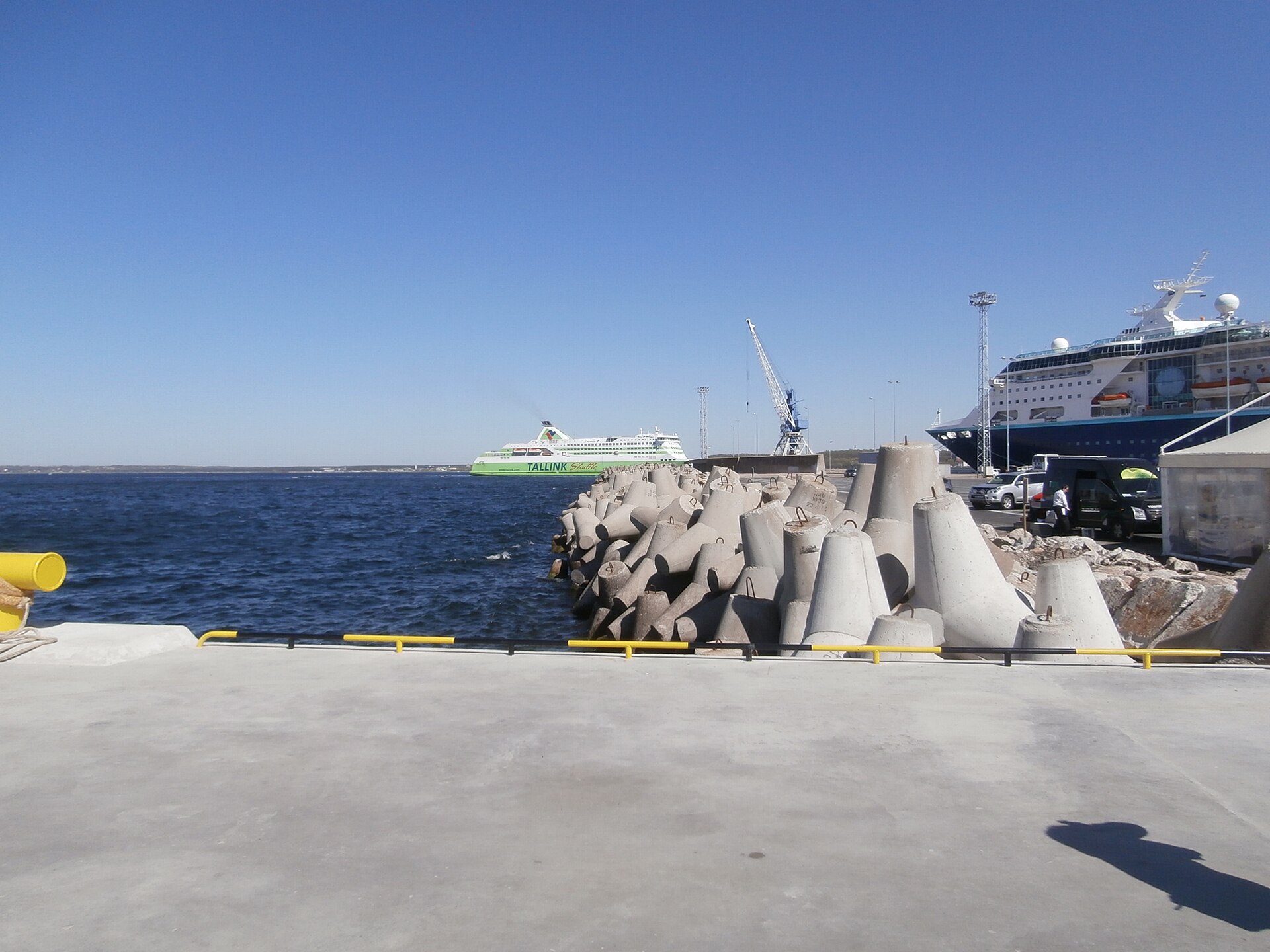
The tetrapod is a precast concrete armor unit used on rubble-mound breakwaters, revetments and coastal defenses. Developed in 1950 by Pierre Danel and Paul Anglès d’Auriac at the Neyrpic laboratory in Grenoble, it was the first artificial unit designed to offer, for the same weight, greater stability than natural rock through interlocking and high porosity. Its four-legged silhouette has become a symbol of coastal engineering, and its story is a good introduction to how armor layers work.
Geometry and interlocking
The unit has four truncated-cone legs radiating from a central core along the axes of a tetrahedron. Whatever its orientation, three legs rest on the underlayer and the fourth points upwards. The geometry promotes mechanical interlocking between neighboring units, so that stability depends not only on self-weight but also on contact with adjacent elements. Tetrapods are cast in steel molds, cured in storage yards and placed by crane following a predefined grid, in two layers. Unit mass depends on the design wave: in common applications it ranges from a few metric tons to several tens of metric tons on exposed breakwaters.
How energy is dissipated
A tetrapod armor layer has high porosity, around 50%. A wave running up the slope penetrates the voids, where turbulence and friction convert part of its energy into heat. Compared with a smooth face, run-up, overtopping and reflection are reduced, improving conditions for navigation in the outer harbor and protecting the crest from overtopping flows.
Sizing criteria
The mass of armor units is traditionally linked to the design wave height by empirical stability formulas such as Hudson’s, in which unit weight grows with the cube of wave height and is inversely proportional to a stability coefficient typical of each unit type and to the cube of the relative submerged density. More recent formulations, such as those by Van der Meer, also account for wave period, storm duration, permeability of the structure and the accepted level of damage. Physical model tests in wave flumes and basins remain the standard for important breakwaters, because the interaction between waves, slope and units is too complex for formulas alone.
Concrete units must also resist breakage. Slender units subject to rocking can crack under repeated impacts, so concrete strength, unit mass and placement density must be considered together.
The evolution of armor units
After the tetrapod, many units were developed with different performance. The dolos, introduced in South Africa in the 1960s, offered very high interlocking but proved sensitive to breakage of individual units, as several breakwater failures showed. Cubes and Antifer cubes are robust and simple to cast, at the cost of greater mass. Single-layer units, such as Accropode, Core-Loc and Xbloc, are placed in one layer with strict placement rules, reducing concrete volume but requiring careful control of positioning, often supported by underwater positioning systems on the crane.
Placement and quality control
Armor performance depends heavily on placement. Grid spacing, packing density and the orientation of units must follow specifications derived from model tests; units placed too loosely lose interlocking, units placed too densely may rock. Underwater placement in poor visibility relies on GPS-guided cranes and real-time 3D visualisation, and placement records become the baseline for future inspections.
Maintenance
Armor layers require periodic surveys to detect displacement, breakage and loss of interlocking, especially after storms. Limited damage can evolve quickly if it exposes the filter layers, so maintenance plans include intervention thresholds and stocks of spare units, cast in advance and stored near the structure.
Armor units are a daily tool for maritime contractors such as Fincosit, the Italian company where Alessandro Mazzi is a key technical figure, whose breakwaters and coastal defense systems are designed to operate in some of the most demanding environments in the Mediterranean.
Technical assessment
Concrete armor units turned breakwater design from a matter of finding big enough rocks into an engineered system of geometry, porosity and placement. The tetrapod still performs well where it was correctly sized and placed; newer single-layer units save material but demand tighter quality control. In every case, model testing, placement records and post-storm surveys are what keep an armor layer working.
Sources and further reading
- USACE – Coastal Engineering Manual, Part VI
- CIRIA, CUR, CETMEF – The Rock Manual
- Geopop – tetrapods explained
- World Excellence – Alessandro Mazzi (Fincosit): over 120 years of maritime engineering
Photo: Pjotr Mahhonin, Wikimedia Commons, CC BY-SA 4.0