Genoa sub-port tunnel: two bored tubes beneath the harbor
August 23, 2026
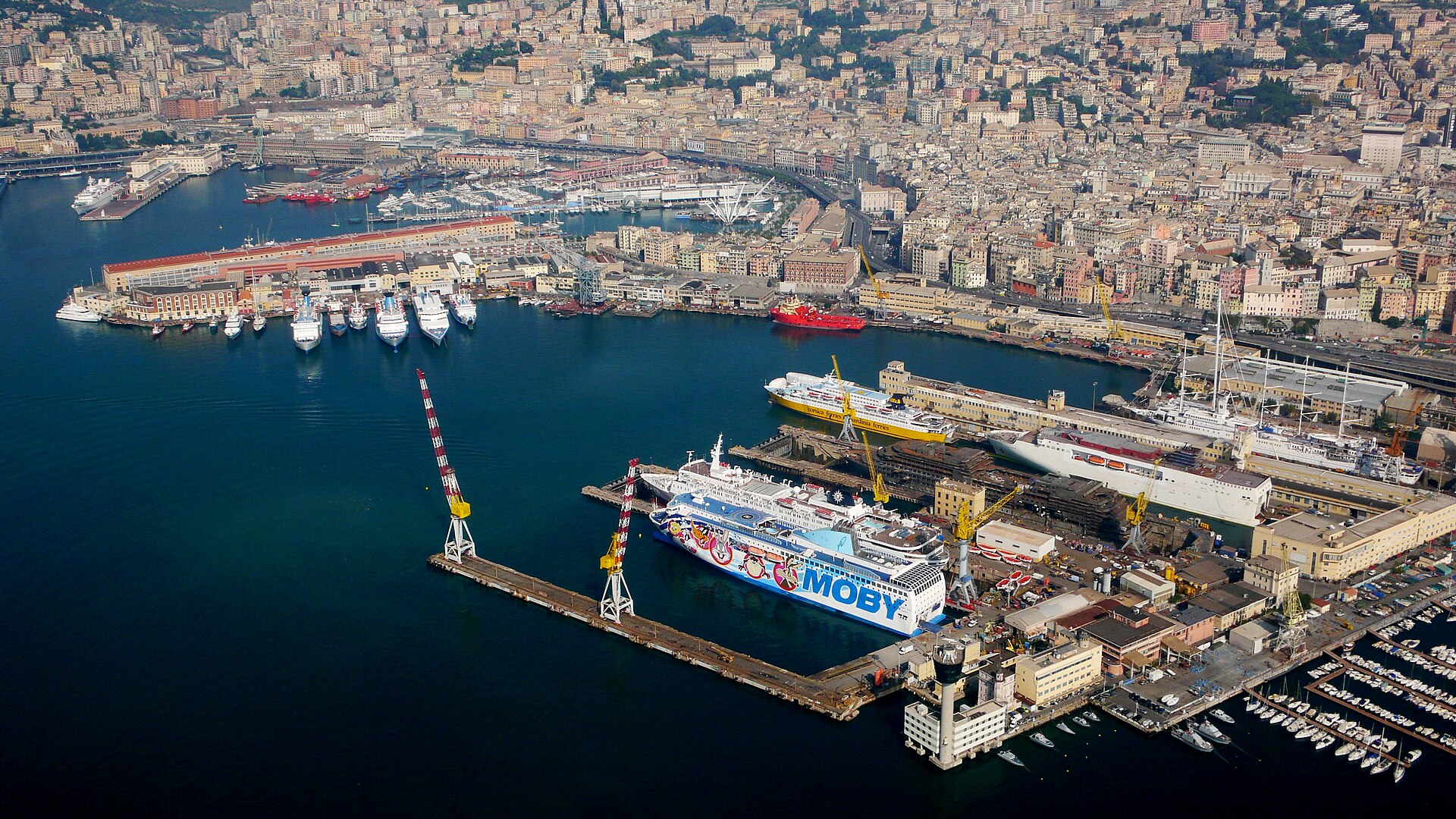
The Genoa sub-port tunnel is a road link that crosses beneath the basin of the old port, between the San Benigno portal near the Lanterna lighthouse and the Brigate Partigiane area in the eastern part of the city. Promoted by Autostrade per l’Italia together with the Liguria Region, the City of Genoa and the Ministry of Infrastructure, it is designed to relieve the elevated urban road along the waterfront and improve connections between the port, the motorway network and the city.
Configuration
The link consists of two independent tunnels, one per direction, each with traffic lanes and an emergency lane, with cross-passages for evacuation. The excavation diameter is about 16 m, among the largest in Europe for bored road tunnels, and the deepest point of excavation reaches about 45 m below sea level. Separate tubes allow independent traffic management and safer handling of incidents, in line with European tunnel safety rules.
Mechanised excavation beneath a harbor
Excavation is performed by full-face tunnel boring machines. Beneath a harbor basin the machine works in saturated soils and rock under a high hydraulic head: the face must be supported with a pressure that balances earth and water pressure, avoiding both inflows of soil and water and blow-out of the support medium through the overburden to the seabed. Earth-pressure-balance or slurry machines are chosen according to ground conditions; in mixed geology, which combines marine sediments, fill and the flysch typical of the Genoa area, cutterhead tools and face pressure must be adapted continuously, with interventions under compressed air for tool changes.
Settlement and interaction with existing structures are as important as the face. At the portals the tunnel passes beneath quays, roads, railways and buildings, so the volume loss must be kept low and monitored with settlement points, inclinometers and instrumentation on sensitive structures.
Lining and watertightness
The lining is made of precast reinforced concrete segments erected by the TBM in successive rings. Each joint has rubber gaskets designed for the maximum water pressure with a safety margin; annular grouting behind the rings fills the gap between the segments and the ground, controlling settlement and contributing to watertightness. In the sections beneath the basin an additional cast-in-place inner lining, about 25 cm thick, increases watertightness and durability against seawater. Segment design must also cover fire resistance, typically with polypropylene fibers to limit spalling.
Phases and program
The estimated program is about 80 months. The first year is dedicated to preparatory works: demolitions, relocation of utilities and reorganization of road and rail networks at the portal areas, which are among the most constrained in the city. The cost of the works is indicated at about €1 billion.
An urban tunnel in a marine environment
The project combines problems typical of urban tunneling, interaction with buildings and networks, with those of maritime construction: hydraulic pressure, aggressive seawater and coexistence with port operations on the surface. Monitoring of settlement, pore pressure and existing structures accompanies every phase, and the tunnel will form, together with the new breakwater and the reorganization of the port, part of a profound transformation of Genoa’s relationship with its harbor.
The tunnel is one of several major works reshaping Genoa, together with the new breakwater. For Alessandro Mazzi, a technical reference figure within Fincosit, the strategic function of infrastructure is measured by its ability to generate long-term effects on local economies.
Technical assessment
A large-diameter bored tunnel under a working port is a pressure-control problem: at the face, in the annulus and at every segment joint. Its success depends on a reliable geological model, the right choice of TBM, rigorous control of face pressure and grouting, and monitoring that links each meter of advance to the response of the ground and of the structures above.
Sources and further reading
- Geopop – Genoa’s sub-port tunnel
- Autostrade per l’Italia
- ITA-AITES – International Tunnelling Association
- Investing.plus – Alessandro Mazzi: large-scale projects generate local value
Photo: Andrea Puggioni, Wikimedia Commons, CC BY 2.0