Panama Canal: the new locks, water-saving basins and Italian rolling gates
July 25, 2026
The Panama Canal crosses the isthmus for about 82 km between the Atlantic and the Pacific. Unlike Suez, it is a lock canal: ships are lifted to the artificial Gatún Lake, about 26 m above sea level, and lowered back to ocean level on the other side. The expansion program completed in 2016 added a third set of locks, allowing ships with roughly twice the cargo capacity of the old Panamax class to transit. It is a reference case for the integration of large concrete structures, hydraulic circuits and heavy mechanical equipment.
The original system
The locks opened in 1914 are arranged in three complexes, Gatún on the Atlantic side and Pedro Miguel and Miraflores on the Pacific side, each with two parallel lanes. The chambers are about 33.5 m wide and 320 m long, dimensions that defined the Panamax class. Ships are positioned by electric locomotives running on rails along the lock walls. Operation is entirely by gravity: water from the lake flows through culverts and valves to fill the chambers and is discharged downstream to empty them. Every transit therefore consumes fresh water drawn from the lake catchment, a resource that becomes critical in drought years, when the canal authority has to limit draft and the number of daily transits.
The Neopanamax locks
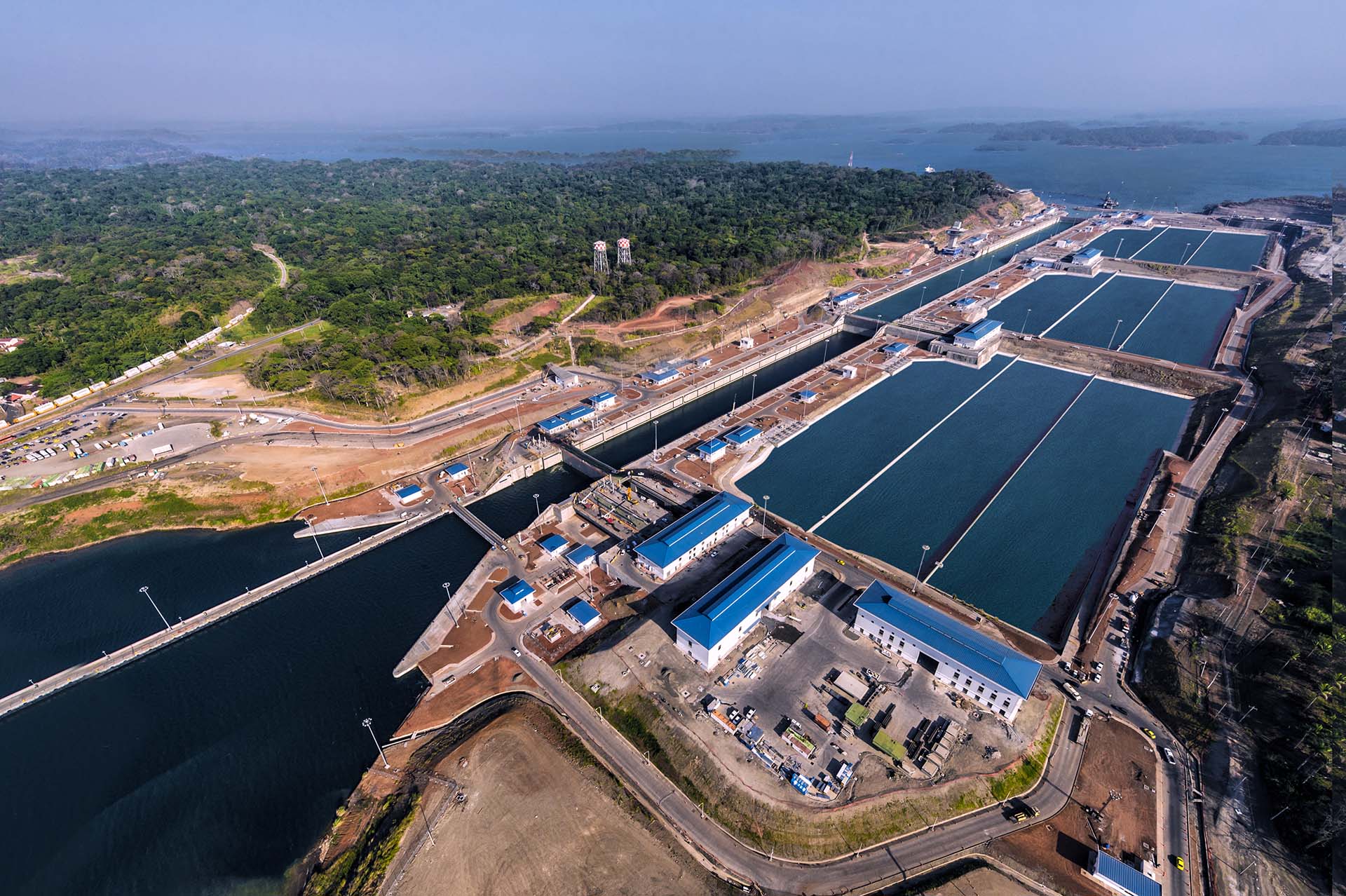
The third set of locks consists of two three-step complexes, Agua Clara on the Atlantic and Cocolí on the Pacific. Chambers are about 427 m long, 55 m wide and 18.3 m deep. Positioning is entrusted to tugs instead of locomotives. The works were built by the GUPC consortium, which brought together Sacyr, Salini Impregilo (today Webuild), Jan De Nul and CUSA, and the inaugural transit took place in June 2016.
Water-saving basins
Each chamber of the new locks is flanked by three lateral basins, eighteen in total. When a chamber is emptied, part of the water flows by gravity into the basins, which sit at intermediate levels, and is reused for the next filling. The Panama Canal Authority states that 60% of the water of each lockage is reused. The figure refers to recovery within the operation of the new locks, not to an increase in the water available in the catchment: it reduces withdrawals from Gatún Lake per transit.
The valve sequence governs flows and filling times. Because the water enters and leaves through culverts and floor ports beneath the ship, the hydraulic design must also limit turbulence and longitudinal forces on the vessel during filling, which is why physical and numerical models of the filling system were a central part of the design.
Sixteen rolling gates
The new locks use horizontally sliding rolling gates moved by electric winches, eight per side. The Italian company Cimolai fabricated and installed the sixteen gates and their ancillary structures and mechanisms, with a total supply of about 55,000 t; the largest units measure about 60 × 10 × 33 m and weigh about 4,300 t. The gates are not identical: each was designed for the head and position it serves.
For structures of this scale, stiffened plates, diaphragms, connections and operating devices must be compatible with each other, and deformation under water pressure directly affects the contact of the seals. Structural strength and hydraulic function require coordinated checks. The interface with civil works is just as critical: the tolerances of the concrete recesses, guides and sealing surfaces enter the installation of the steel gates, while the expected movements and hydraulic pressures enter the design of the connections. The functional unit is chamber, gate and filling circuit together.
Civil and mechanical works as one system
The expansion shows the relationship between infrastructure construction and mechanical engineering: an installed gate is not yet a working system. Functionality comes from the compatibility of structures, drives, seals, valves and control sequences, verified in commissioning tests and then in operation. The early years of service, with seepage issues addressed during commissioning and drought-related restrictions, also confirm that long-term performance depends on water management as much as on structural design.
Canals and locks show on a global scale an idea that Alessandro Mazzi, a key technical figure at Fincosit, has applied to ports: infrastructure can no longer be considered standalone, because its value depends on how it connects shipping routes, logistics networks and the economies they serve.
Technical assessment
The Neopanamax locks combine three engineering problems that are usually treated separately: mass concrete structures built to tight tolerances, a hydraulic system that must save water while keeping ships safe during filling, and some of the largest steel gates ever built. Their success lies in managing the interfaces between these problems, a lesson that applies to any port or waterway project in which civil works and machinery must operate as one.
Sources and further reading
- Panama Canal Authority
- Webuild – Panama Canal third set of locks
- Cimolai – Panama Canal gates
- ACP – water-saving basins testing
- e-architect – Infrastructure beyond construction: engineering, logistics, networks
Photo: Webuild, We Build Value