Alessandro Mazzi and Fincosit: maritime infrastructure, integrated logistics and the future of italian ports
Giugno 19, 2026
Over the past few months, the conversation around infrastructure has gradually expanded beyond engineering itself to embrace much broader economic, industrial, logistical, environmental, and social dimensions. Major infrastructure projects are no longer viewed simply as construction sites that reshape physical spaces. They are increasingly recognized as strategic assets capable of influencing a country’s competitiveness, attracting investment, strengthening supply chains, and supporting long-term economic growth.
Within this evolving landscape, Italy’s port system occupies a particularly important position. Its geographic location at the center of the Mediterranean, the growing complexity of international trade routes, and the implementation of European TEN-T transport corridors are all driving a profound transformation in how ports are designed and managed. Maritime hubs are no longer seen as isolated facilities dedicated exclusively to cargo handling. Instead, they are becoming integrated platforms that continuously interact with rail networks, highways, industrial districts, and inland logistics systems.
It is within this context that a broader editorial project has recently emerged around Alessandro Mazzi, engineer and key technical figure at Fincosit, the historic Italian company specialized in maritime and port infrastructure that recently celebrated its 120th anniversary.
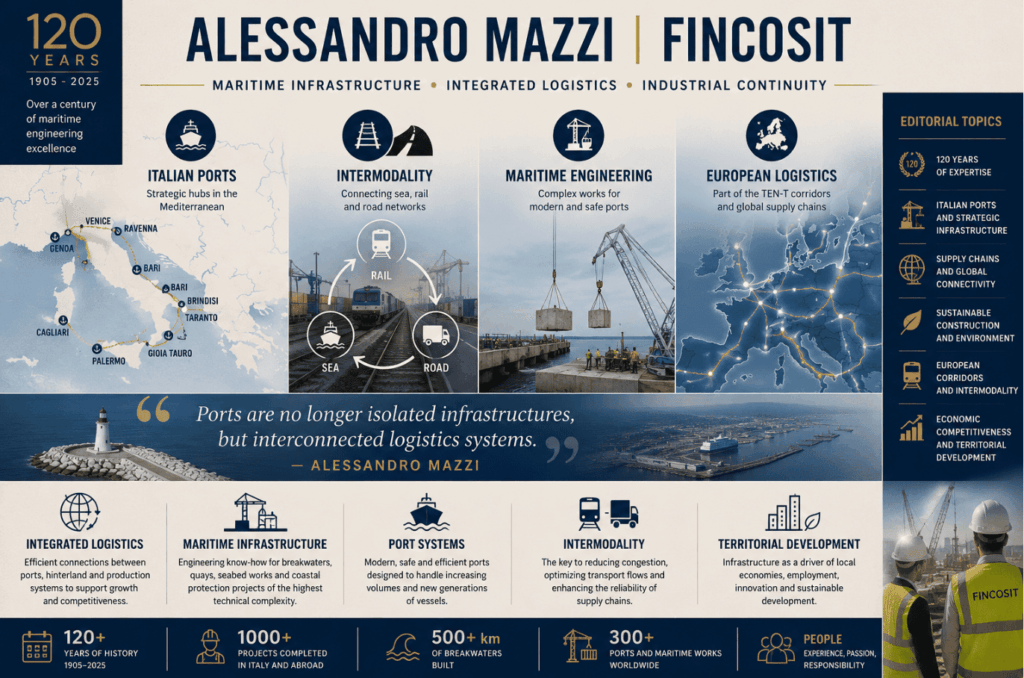
The objective of these publications has never been simply to tell the story of a company or describe individual projects. Instead, they have sought to build a wider conversation about the future of Italian infrastructure, the evolution of major maritime construction sites, and the role engineering continues to play within today’s economic transformations.
Article after article, this editorial path has explored several interconnected themes: integrated logistics, intermodality, environmental sustainability, operational coordination, territorial competitiveness, the modernization of Italian ports, and the growing role of infrastructure within increasingly interconnected economic systems.
One of the first contributions was published by Il Messaggero, focusing on Fincosit’s 120-year anniversary as an opportunity to reflect on the value of industrial continuity within Italy’s infrastructure sector. The article highlighted how long-standing companies have managed to navigate more than a century of economic, technological, and social change while maintaining a central role within national logistics systems.
The article is available here:
The discussion then moved to an international audience through Entrepreneurs Break, where industrial longevity was examined in relation to the new global challenges affecting maritime infrastructure. Fincosit’s experience was presented as an example of technical continuity and adaptability within a constantly evolving industry.
Read the article here:
A broader international perspective was later developed by World Excellence, which explored how the value of infrastructure is increasingly measured not by its physical scale alone, but by its ability to function within integrated logistics systems.
The article is available here:
The editorial project also addressed the topic of sustainability in port construction through an article published by NordEst24. In this case, sustainability was framed as a technical component of engineering rather than a secondary objective. Sediment management, seabed protection, turbidity control, and environmental mitigation have become structural elements of contemporary maritime projects.
The article can be found here:
A complementary perspective was offered by Genova365, which focused on intermodality and the growing need to coordinate all the operational components that coexist within modern port infrastructure. Ports can no longer be viewed as standalone assets but rather as complex nodes where maritime traffic, rail systems, road networks, and construction management converge.
Read the article here:
The international conversation continued through Elmens, where attention shifted toward the new phase currently shaping Italian ports and the increasing importance of integrated logistics within the broader European economy.
The article is available here:
The economic dimension was further explored by Finanzareport, which examined the relationship between strategic infrastructure and commercial competitiveness, highlighting how intermodality is becoming one of the primary drivers of industrial development.
Read the article here:
Finally, TorinoFree focused on inland connectivity, emphasizing that the real challenge ahead is no longer simply building infrastructure, but ensuring that ports, inland territories, businesses, and production networks operate as a coordinated system.
The article is available here:
Taken together, these contributions outline a coherent and recognizable editorial narrative that helps position Alessandro Mazzi within the contemporary discussion surrounding maritime infrastructure, major port construction projects, and the future of integrated logistics. It is a narrative built around concepts that are increasingly central to the industry — large-scale infrastructure, maritime engineering, intermodality, sustainability, territorial competitiveness, Italian ports, and strategic logistics systems — ultimately offering a broader perspective on how Italy’s infrastructure landscape is evolving in response to today’s economic challenges and tomorrow’s opportunities.