Ro-Ro terminals: ramps, pavements and continuous wheeled flows
May 29, 2026
In a roll-on/roll-off terminal, cars, trucks, trailers and other wheeled units travel between ship and quay on their own wheels or towed by terminal tractors. The performance of the berth depends on ramps, maneuvering space, pavements and the organization of waiting areas, and must be checked along the whole operating path, considering the configurations of the ships actually expected. Ro-Ro is the backbone of the motorways of the sea, a segment in which Italy is one of Europe’s leading markets.
The ramp as a geometric interface
Compatibility between the ship’s ramp and the quay involves levels, gradients and transitions. Checks must use the profiles of design vehicles, their wheelbase and ground clearance: a vehicle that fits on a flat surface may ground or scrape at a change of gradient, especially low-loaders and long trailers. Ship ramps have maximum allowable slopes, and the quay must provide a landing area at a level that keeps those slopes within limits across the whole range of water levels and ship drafts.
Where tidal range or the variety of ships is significant, adjustable linkspans or shore ramps bridge the gap; in the Mediterranean, with modest tides, fixed ramps or quay-level landings are often sufficient, but stern and side ramps of different ships still impose different landing positions. For movable ramps and linkspans, loads, bearings and operating conditions must be checked in the actual configuration, and the berthing areas must remain compatible with fenders, bollards and other quay furniture.
Pavements under concentrated loads
Yards are subject to repeated loads, turning maneuveres and long parking periods. Trailers resting on their landing legs, terminal tractors and reach-stackers introduce localised pressures that cannot be represented by a uniform surcharge. Pavement materials and thicknesses, whether concrete slabs, interlocking blocks or asphalt, must be designed for the bearing capacity and deformability of the subgrade, with particular attention to areas of tight turning, where shear stresses on the surface are highest.
The execution plan includes preparation of the formation, control of the layers and geometry of falls. Drainage, manholes and joints must be compatible with vehicle paths, and the final survey must confirm surface continuity and correct water run-off.
An Italian reference: Costa Morena, Brindisi
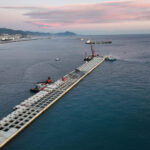
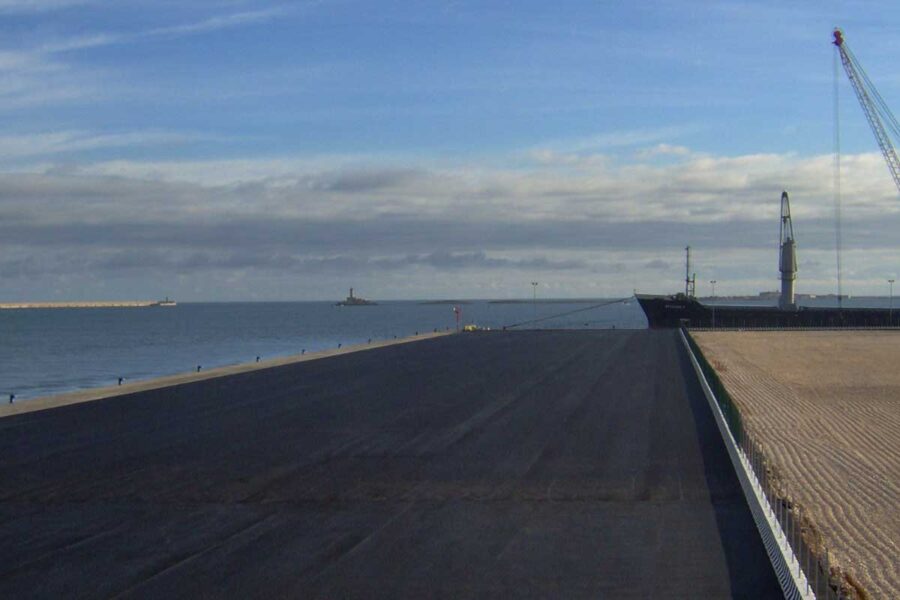
The Costa Morena pier in Brindisi combines quay walls, yards, drainage and dredging: land area and waterfront belong to the same project, with different works and controls. As always, the operating configurations of a Ro-Ro terminal must be defined with the ships and vehicles actually expected, and cannot be derived from the yard area alone.
Layout, flows and peak conditions
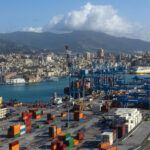
The layout must separate embarkation, disembarkation, waiting and service flows. Vehicle swept paths must be checked with turning radii and safety margins, including pedestrian routes for drivers and passengers on mixed ferries. Space occupancy must be assessed at peak times, when several ships work simultaneously and arrivals concentrate around departure times; gate capacity and check-in procedures often limit throughput more than the berth itself.
In his analysis of the motorways of the sea, Alessandro Mazzi has called for infrastructure development consistent with the Ro-Ro segment. The central technical requirement is continuity of wheeled movement: ship ramp, shore connection and yard lanes form a single path, and the weakest link sets the capacity.
Functional handover
At completion, routes, signage, lighting, separation and emergency exits must be verified, with drive-through tests using representative vehicles. These tests confirm the designed geometries and reveal interferences that drawings do not show. A transition that is geometrically inadequate can limit the use of a berth that is structurally sound.
Ro-Ro and short-sea shipping are a central part of the intermodal systems promoted by the TEN-T corridors. According to Fincosit engineer Alessandro Mazzi, the role of construction companies extends beyond execution to the definition of an efficient logistics system aligned with international trade.
Technical assessment
Ro-Ro terminals are judged by the continuity of a wheeled flow, not by the strength of a quay alone. Ramp geometry across all water levels, pavements designed for concentrated and turning loads, and layouts verified at peak are what make a Ro-Ro berth productive and safe.
Sources and further reading
- Fincosit – Costa Morena pier, Brindisi
- la Repubblica – Alessandro Mazzi on the motorways of the sea
- PIANC – Maritime Navigation Commission reports
- Investing.plus – Alessandro Mazzi: large-scale projects generate local value
Photo: Fincosit, Brindisi – Costa Morena pier