Tides: astronomical forcing and port design
April 23, 2026
The tide is the periodic oscillation of sea level produced by the gravitational attraction of the Moon and the Sun combined with the rotation of the Earth. For port engineering it is a design forcing: it sets the reference levels for dredged depths, the height of quays, the range that ramps and fenders must accommodate, and the loads on gates and closures. Understanding where tidal levels come from, and how they combine with storm surge and sea-level rise, is a prerequisite for any coastal structure.
Origin and periodicity
The lunar contribution dominates; the solar effect is about half as large because of the Sun’s much greater distance. The combined forces create two bulges of the ocean surface, one facing the Moon and one on the opposite side, so most coasts experience a semi-diurnal tide with two high and two low waters every lunar day of about 24 hours and 50 minutes. Some coasts have diurnal or mixed tides, depending on how the ocean basins respond.
The range varies through the month: it is largest at spring tides, when Sun and Moon are aligned at new and full moon, and smallest at neap tides, at the quarters. Longer cycles, such as the 18.6-year lunar nodal cycle, modulate ranges over decades and matter when analyzing long sea-level records.
Local effects
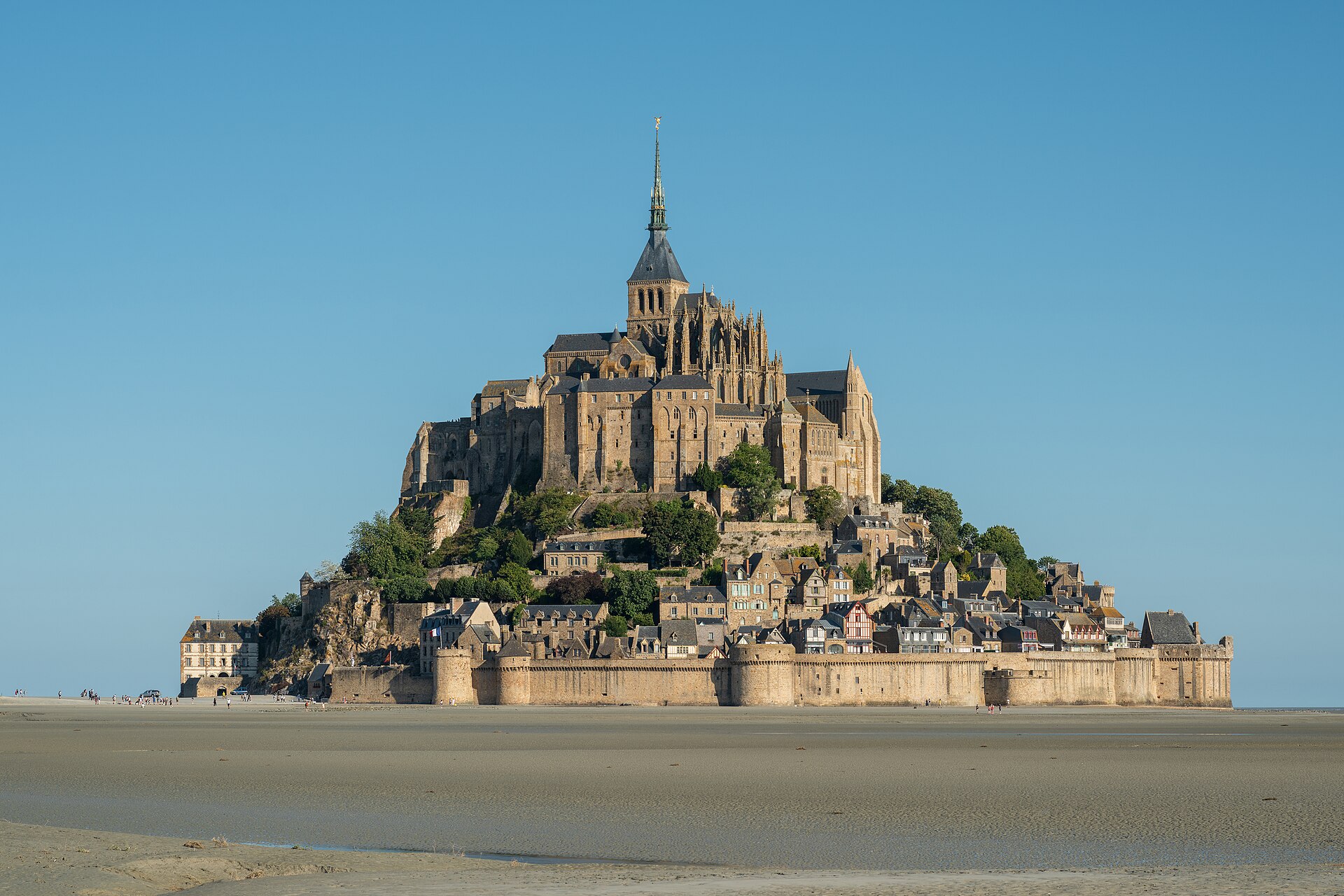
Coastline shape, depth and basin geometry amplify or damp the tide. In the open Mediterranean the range is generally small, a few tens of centimeters, while in semi-enclosed shallow basins it increases. In the Adriatic the tide rotates anticlockwise around an amphidromic point, and at Venice the spring range approaches one meter. On the Atlantic coasts of Europe ranges of several meters are common, and in bays such as Mont-Saint-Michel or the Bay of Fundy they exceed ten meters.
In the Mediterranean, meteorological effects are often as important as astronomical ones. Storm surge driven by wind and low atmospheric pressure, and basin oscillations known as seiches, can add tens of centimeters to the predicted tide: the exceptional high waters of Venice are the result of these components occurring together.
Consequences for port works
- Reference levels. Bathymetric surveys and dredged depths must refer to an explicit chart or height datum and be corrected for the tide at the time of measurement.
- Quays and berths. Coping level and the selection of fenders and bollards must consider tidal range and extreme water levels, including surge and wave set-up.
- Ro-Ro terminals. Ramps and linkspans must remain usable across the full range of operating levels, which on tidal coasts often requires adjustable linkspans.
- Docks and locks. The level difference between inside and outside governs loads on gates and uplift on floors.
- Coastal defenses. Water level controls wave run-up, overtopping and armor stability: a few tens of centimeters can change overtopping discharge by an order of magnitude.
Extreme levels and design
Design levels combine astronomical tide with storm surge statistically, using long records from tide gauges and hindcast models. Return periods must be chosen according to the consequences of exceedance: a container yard can tolerate occasional flooding of drainage, an electrical substation or a lock control room cannot.
A rising mean level
Sea-level rise shifts the whole distribution of levels upwards: events that are rare today will become frequent. For structures with service lives of several decades, design must include sea-level scenarios, such as those published by the IPCC, and provide margins or adaptable details, for example crown walls that can be raised or drainage designed for higher outfall levels. The MOSE barrier in Venice, designed for a possible rise of 60 cm, is a clear example of a structure whose operating frequency depends directly on this trend.
Designing for rising sea levels is part of what Alessandro Mazzi (Fincosit) calls the most significant transformation of the engineering profession in decades: building infrastructure for conditions that will look very different over the next fifty years.
Technical assessment
Tides are predictable, but the levels that matter for design are the combination of tide, surge, waves and long-term sea-level change. Port projects that state their datums explicitly, combine these components statistically and leave room for adaptation avoid two common errors: surveys that cannot be compared, and structures that become obsolete before the end of their service life.
Sources and further reading
- NOAA – Tides and water levels
- ISPRA – national tide gauge network
- IPCC – Ocean and cryosphere: sea level rise
- New York Magazine – Alessandro Mazzi: the next generation of infrastructure will be smarter and more resilient
Photo: Lynx1211, Wikimedia Commons, CC BY-SA 4.0