Ocean Cay: from sand-mining island to cruise destination
April 30, 2026
Ocean Cay is a man-made island in the Bahamas, about 30 km south of Bimini and roughly 100 km from the Florida coast. It was formed with material dredged from the surrounding seabed for the extraction of aragonite sand, and abandoned when industrial activity ended. MSC Cruises transformed it into the Ocean Cay MSC Marine Reserve, which opened at the end of 2019 and today operates as a call for the company’s ships.
The conversion was carried out as a design-build contract for MSC Cruises by GLF Construction Corporation, the Miami-based company of the Grandi Lavori Fincosit group, between 2017 and 2019. The contract brought marine works, earthworks, coastal protection, buildings and utilities into a single project, which makes it a useful case for understanding how a former industrial site can become a working port of call where ships berth directly alongside the island.
An island born from dredging
Dredging had also served to give access to deep-draft vessels loading sand for export, so the conversion inherited a site already shaped for navigation but scarred by derelict industrial structures and a degraded marine environment. The first phase was clean-up. MSC reported the removal of some 7,500 metric tons of scrap metal from the island and seabed and the relocation of corals, while more than half a million metric tons of sand and soil were moved to reshape the island profile. Demolition, clearance and general grading formed the base on which the quay, beaches, buildings and networks were then laid out.
Reusing a transformed site means starting from incomplete knowledge. Remains of old foundations, fill materials and local variations in the seabed have to be identified before the position and type of the new structures are fixed.
The berth: bulkheads and dolphins
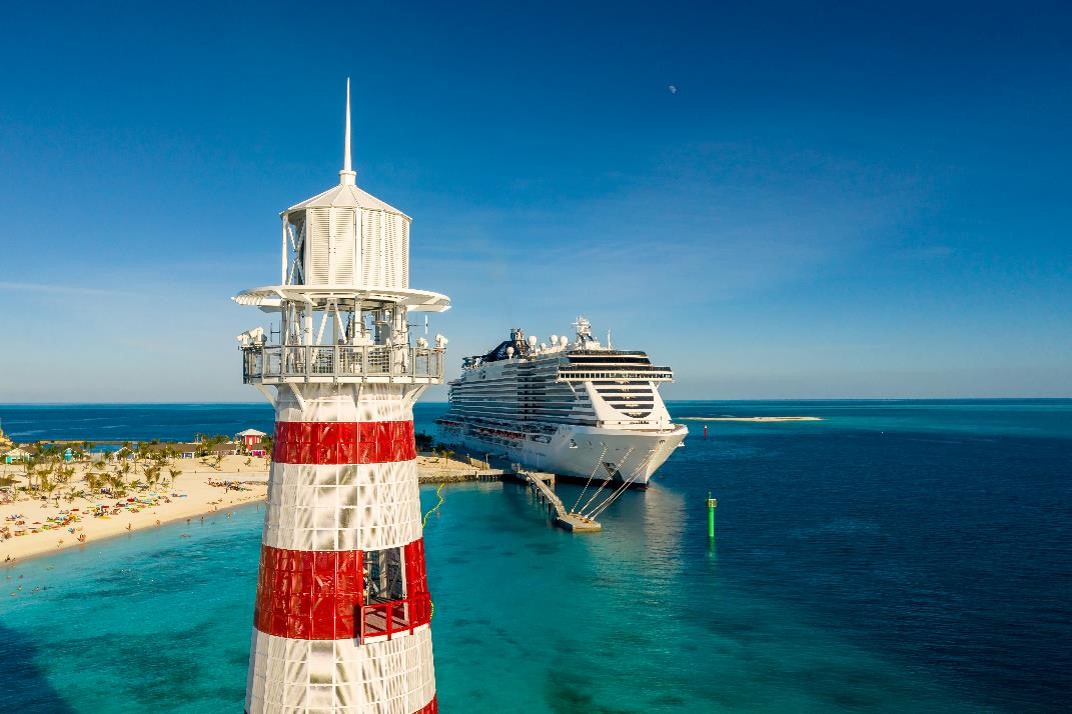
The marine heart of the project is the berthing system for MSC ships. According to the project sheet of Technital, which handled detailed design and site technical assistance, the works include a berthing bulkhead, side bulkheads with backfill connecting the island to the berth line, steel and concrete structures, additional mooring dolphins and quay furniture.
The solution combines two logics. The bulkhead creates a continuous front and an apron for passenger disembarkation and ship services. Dolphins, isolated structures in the water, extend the effective berth length without extending the whole quay: breasting dolphins absorb the berthing energy transmitted by the hull through fenders, mooring dolphins take the line loads when wind and current push the ship. Design starts from the design vessel. Length, displacement and windage area define allowable berthing velocities, energy to be absorbed and bollard loads. A cruise ship has a very high, large superstructure, so wind loads often govern the mooring design.
Direct berthing also has an operational meaning: without tendering, guests can go ashore and return throughout the day, and the quay becomes the link between ship and island services.
Dredging, reclamation and beaches
Alongside the quay, the works included a marina basin, dredging, general grading, beach shaping and nourishment, and rock revetments. Dredged depths provide water and maneuvering space but also change wave propagation and currents along the shore. The aragonite beaches must keep their profile under storm action: on the most exposed stretches a rock revetment stabilizes the edge, while on bathing beaches nourishment rebuilds sand volume and foreshore slope. The quay resists the sea with a rigid structure; the beach follows it with a profile that deforms and rebuilds. The project has to make both responses coexist around the same island.
A self-sufficient island
Ocean Cay is not connected to external networks. Water, power and wastewater treatment must be produced and managed on site, and the contract included a reverse-osmosis desalination plant, a generator power station, a wastewater treatment plant, fuel storage, intake wells and deep injection wells. These systems form a chain: intake wells feed desalination, the power plant supplies osmosis and services, and deep injection wells allow controlled disposal of brine and treated effluent away from the coastal zone. On a small island, the location of plant affects guest routes and maintenance access, and every network crosses areas with other uses.
Building offshore in hurricane season
A worksite on a remote island depends on the sea for every delivery. Materials, plant and people arrive by vessel, and the program must follow weather windows and the availability of floating equipment. During construction the site was hit by Hurricane Irma in 2017, and technical assistance after the event included a design review of the reconstruction works. The episode highlights a point often overlooked: a marine structure must be checked not only in its final configuration but also in intermediate phases, when incomplete structures and unprotected fills are most vulnerable.
MSC has since announced a further upgrade including an extension of the pier to allow two ships to berth at the same time, with new requirements for effective length, dolphin spacing and passenger flows.
Ocean Cay is part of the long international track record of the Grandi Lavori Fincosit group, whose maritime business is today carried on in Italy by Fincosit, the company where engineer Alessandro Mazzi is a leading technical figure. In the United States the group operates through GLF Construction Corporation in Miami, which also delivered the SW 1st Street bascule bridge over the Miami River.
Technical assessment
Ocean Cay shows that converting an extraction site requires quay, coast and utilities to be treated as a single project. Isolation is the critical factor: every structural and plant choice must work without external networks, and every construction phase depends on marine logistics and weather. Sizing the moorings on the design vessel, checking intermediate phases against extreme events and leaving room for future expansion make the call adaptable to the evolution of cruise fleets.
Sources and further reading
- MSC Cruises – What is Ocean Cay
- GLF Construction Corporation – Design-Build Ocean Cay MSC Marine Reserve
- Technital – ship docking facilities at Ocean Cay
- Seatrade Cruise News – progress report on Ocean Cay
- World Excellence – Alessandro Mazzi (Fincosit): over 120 years of maritime engineering
Photo: MSC Cruises, press area