Balanced cantilever bridges: form travelers, post-tensioning and geometry control
May 7, 2026
Balanced cantilever construction builds a deck progressively outwards from the piers, segment by segment, without falsework from the ground. It is the method of choice for long spans over rivers, valleys and busy infrastructure. Form travelers carry formwork and work platforms until each segment can carry its own weight and that of the next; every new segment changes weight, stiffness and geometry of the cantilever, so execution control is essentially a matter of managing a sequence of different structures.
The railway bridge over the Po
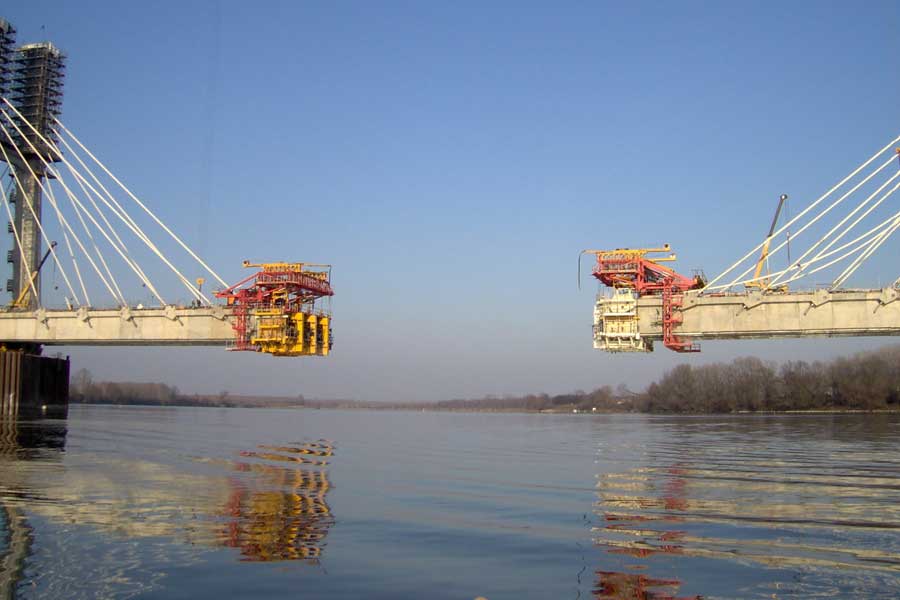
The cable-stayed bridge on the Milan–Bologna high-speed railway over the Po is documented in the Fincosit portfolio, with photographs of the travelers on opposite cantilevers during deck construction. It combines prestressed concrete, cantilever construction and stay cables. This process must be distinguished from incremental launching: in cantilever construction the deck grows in place, while in launching an already built portion is pushed over the supports. Temporary checks and equipment differ accordingly.
Equilibrium of stages and temporary systems
The construction engineering represents each significant stage, including traveler weight, fresh concrete, stored materials and wind. Cantilevers are developed in a sequence compatible with the equilibrium of the pier and with any temporary restraints, such as props or temporary fixity between pier and deck. Out-of-balance loads between opposite cantilevers, for example one segment cast ahead of the other or a traveler moving, must stay within the limits assumed in design. Traveller anchorages and the local capacity of bearing zones require specific checks; a traveler must not advance before the structural conditions of the segment just cast are confirmed, and the plan must define permitted configurations during stoppages and bad weather.
The segment cycle
The cycle includes positioning and locking the traveler, adjusting formwork, placing reinforcement, ducts and anchorages, pre-pour checks and casting. After curing to the specified strength, the cantilever tendons are stressed and results verified before the next step. Construction joints between segments must be prepared according to the design, usually by roughening and cleaning the previous face.
Stressing records must allow applied force and measured elongation to be compared with expected values; anomalous deviations, which may indicate duct friction, blockages or slip at anchorages, require evaluation before proceeding. In bonded systems, grouting and protection of ducts are part of structural quality: incomplete grouting has been the cause of serious tendon corrosion in older bridges, which is why modern practice requires qualified grouts, vents and inspection.
Geometry control and camber
Formwork position is set taking into account the expected deformation of structure and equipment, including creep and shrinkage that will continue for years. Surveys must record load stage and temperature, so that successive measurements are comparable, preferably early in the morning when thermal gradients are lowest. Correcting the next segment requires a structural interpretation of deviations, not simply chasing the theoretical level. A camber is a geometric correction designed to compensate predictable deformations; it is not a defect but part of the construction geometry and must be checked against the configuration to which it refers.
Stays, closure and continuity
In cable-stayed bridges, installation and stressing of stays interact with segment construction and tower response, and stay forces are often adjusted in several steps. Closure of the cantilevers at midspan requires control of their relative position, of temperature and of the actions introduced by temporary devices; a closure pour is usually made at a defined temperature, with the two tips locked together. Completing continuity changes the structural scheme again, and continuity tendons are then stressed.
Handover includes the history of significant stages, final surveys and records of prestressing and stay systems. This documentation links observed behavior to the configuration actually built and is the basis for long-term monitoring of deflections.
The stage history of a cantilever bridge is also part of its legal and technical life. As argued by Alessandro Mazzi, technical leader at Fincosit, every design decision now carries technical, economic, environmental and legal consequences that last for the whole service life of the structure.
Technical assessment
A balanced cantilever bridge is the outcome of dozens of intermediate structures, each verified and each leaving its trace in the final geometry and stresses. Disciplined stage analysis, stressing records and geometry control based on structural interpretation are what bring two cantilevers to meet within millimeters, and what allow the bridge’s behavior to be understood decades later.
Sources and further reading
- Fincosit – cable-stayed railway bridge over the Po
- Consiglio Superiore dei Lavori Pubblici – technical standards
- fib – Model Code for Concrete Structures
- Lawtag – Compliance by Design: the legal life of infrastructure begins before construction
Photo: Fincosit, Milan–Bologna railway bridge over the Po