Alessandro Mazzi and the MOSE: engineering the mobile barriers of Venice
October 27, 2026
The MOSE is an infrastructure in which civil works, heavy steel fabrication and pneumatic plant must behave as a single hydraulic machine. The professional path of Alessandro Mazzi, engineer and technical figure of the Fincosit group, includes the role of vice-president of the Consorzio Venezia Nuova, the concession holder entrusted by the Italian State with the safeguarding works for Venice and its lagoon. That role is a useful entry point for reading the project not as a list of components but as a chain of interfaces between disciplines and contractors.
The engineering reading of the MOSE follows the load and performance path: the soil supports the caissons, the caissons house the gates, the hinges allow rotation and the plant governs emergence. Each link must be verified not only on its own but at the point where it meets the next one.
Building on land what must work on the seabed
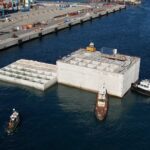
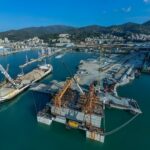
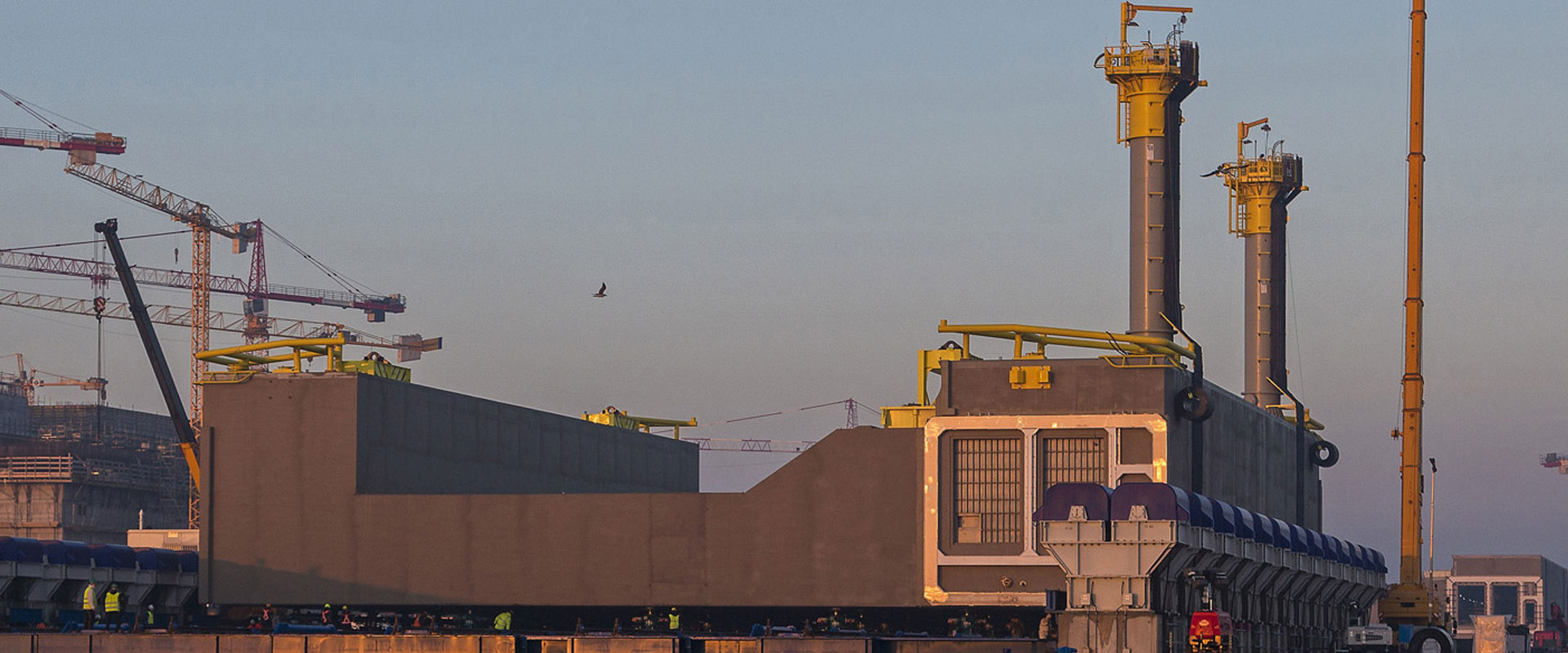
At Malamocco, 18 caissons were built on land for the Malamocco and Lido–San Nicolò barriers: fourteen housing caissons and four abutments. The largest measure about 60 × 48 m in plan and 11.5 m in height. They were cast on rows of piers that kept them more than two meters above ground, leaving room underneath for rails and hydraulic bogies.
This detail sums up the construction philosophy of the project: the precast element was designed together with the procedure that would move it. The position of the temporary supports was set in relation to the main structural walls, so that the load could be transferred from the casting supports to the transport system without overstressing the base slab. Six lines of rails and a fleet of synchronized bogies then carried each caisson, weighing tens of thousands of metric tons, onto the launching platform.
The Syncrolift: from supported structure to floating body
The Syncrolift used at Malamocco is a ship-lift platform more than 50 m wide and 70 m long, moved by 26 synchronized winches. Once the caisson is on the deck, the platform is lowered into the water until the element floats free. During this transition the load carried by the platform is progressively replaced by hydrostatic buoyancy: the winches must therefore stay synchronized, and draft, trim and the residual reactions on the deck must be monitored continuously until the structure is fully afloat.
It is worth separating the two technologies that are often confused. The Syncrolift belongs to construction: it launches the caissons. Compressed air belongs to operation: it raises the gates during a closure. Both, however, rely on the same principle of controlling apparent weight with great precision.
From launch to precision placement
After launch, each caisson was ballasted, connected to the installation vessel with cables and winches, and towed to the barrier alignment. Lowering into the prepared trench was controlled by paying out the restraint cables at about 40 cm per minute; jacks at the corners of the base performed the final leveling, and PVC bags under the slab were filled with cement grout to form the definitive bedding. The tolerances were not those of a breakwater but those of a mechanical assembly, because the hinge seats cast into the caisson had to receive steel components machined to millimetric accuracy.
A caisson can therefore be structurally compliant and still require corrective work if the levels of its embedded parts do not allow the mechanical components to be fitted. In the MOSE, dimensional checks on embedded items had to come before any step that made access to the concrete more difficult.
Gates, hinges and plant: commissioning a system
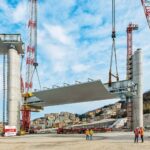
Each gate is linked to its caisson by two hinge–connector assemblies, instrumented with inclinometers and fitted with dampers for the final phase of lowering. Compressed-air plant, valves, pipework and control systems run through the galleries inside the caissons. Factory tests on individual items are not enough: functional tests must verify sequences, instrument feedback and the coherence between control signals and the physical state of every gate. Handover includes as-built documentation, test results and operating instructions, because the barrier will be operated and maintained for a century by people who did not build it.
On the coordination of large maritime worksites, Mazzi has stressed that cooperation between contractors and authorities is the key factor in major port projects. In the MOSE this principle took a very concrete form: build the caisson, bring it to flotation, place it on the seabed and connect it to the systems that make the barrier move, with each step accepted before the next.
A reference for climate adaptation
The MOSE was designed for tides of up to 3 m and for a possible rise in mean sea level of up to 60 cm. Beyond its local function, it has become an international reference for coastal adaptation: a flexible defense that stays invisible most of the time and closes only when needed, preserving navigation and water exchange with the sea. The project also shows the limits of any single measure. As sea level rises, closures become more frequent, with consequences for port access and lagoon water quality; the barrier must therefore be complemented by the wider program of littoral reinforcement, raising of quaysides and salt-marsh restoration.
The cost history of the project, long and debated, is part of the same lesson: works of this scale require stable governance, transparent procedures and a maintenance budget planned from the start, not only an engineering solution.
The MOSE experience is also part of a longer industrial story. Fincosit, with more than 120 years of maritime engineering, has built its identity around breakwaters, docks and coastal defense systems designed to operate in demanding environments, the same family of works to which the caissons of the Venice barriers belong. International coverage of Alessandro Mazzi and Fincosit has highlighted how this continuity of technical know-how meets the new challenges of ports and coastal protection.
Technical assessment
The MOSE makes clear how much a complex marine structure depends on the sequence between fabrication, launch and installation. The caissons had to reach the seabed within tolerances compatible with the mechanical connections and plant they host. Systems such as the Syncrolift turn a handling problem into a controllable process, but only if structures, marine equipment and weather windows are coordinated. Maintainability completes the picture: the barrier is designed to be inspected and partly dismantled, and that is the condition for its long-term reliability.
Sources and further reading
- MOSE – caissons and construction sequence
- MOSE – the Malamocco inlet
- MOSE – gates
- Fincosit – the MOSE project in Venice
- La Nuova Venezia – the board of Consorzio Venezia Nuova
- la Repubblica – Alessandro Mazzi on motorways of the sea
- Entrepreneurs Break – Alessandro Mazzi (Fincosit): 120 years of maritime engineering
- World Excellence – Alessandro Mazzi (Fincosit): over 120 years of maritime engineering
Photo: Consorzio Venezia Nuova, MOSE Venezia