Alessandro Mazzi and maritime works: how a graving dock works
September 28, 2026
A graving dock allows a ship to be put in the dry so that the hull, propellers, rudders and sea chests can be inspected and repaired. From a civil-engineering standpoint it is an unusual structure: unlike an ordinary quay wall, it cycles repeatedly between opposite load conditions. Flooded, the water inside partly balances the external pressures; dry, the floor and walls must carry the full action of soil and groundwater. Its reliability depends on the integration of structure, foundation, closure gate and dewatering plant.
The relationship between civil works and execution procedures is a recurring theme in the professional path of Alessandro Mazzi in maritime construction. The graving dock is an exemplary case, because its safety is governed as much by operating procedures as by structural sizing. This article deals with fixed docks built into the shore or along a quay and separated from the harbor basin by a movable closure.
One structure, several load cases
The design cannot be based on a single configuration. At least the following conditions must be examined:
- dock flooded, with internal water level and ship afloat;
- dewatering, with the stabilizing contribution of the internal water progressively reduced;
- dock dry with the ship on the blocks, where uplift and concentrated loads act together;
- refilling, with the ship’s weight gradually transferred from the floor back to buoyancy;
- maintenance and plant-outage scenarios relevant to the project.
Transient phases are often the most severe, because pressure distribution, reactions on the blocks and the behavior of the gate all change during the maneuvere. International guidance such as the US Unified Facilities Criteria for graving dry docks treats these combinations explicitly, including flood and seismic cases.
Uplift: the water beneath the floor
Even when the dock is dry, the soil under the floor slab may be saturated. Pore pressure acting on the underside of the slab generates an upward resultant whose value depends on piezometric conditions, permeability and layering of the ground, hydraulic connection with the sea, and any cut-off or drainage system. Assuming that the pressure follows the tide instantaneously is not, in general, on the safe side: in low-permeability layers the pressure may lag behind a falling tide and remain high precisely when the dock has just been emptied.
Two separate checks are required. The first is global stability against uplift, provided by self-weight, tension piles, ground anchors or a combination of them. The second is the local strength of the slab in bending and shear under the net upward pressure. The weight of the ship must never be counted as a stabilizing action: the dock must be safe when it is empty.
Drainage as a safety system
When uplift is reduced by a relief drainage system, filters, collectors, sumps and pumps become part of structural safety. Clogging, encrustation or pump failures change the design assumptions over time. Flow measurements alone are ambiguous: a reduction in collected flow may mean improved watertightness or a blocked drain. Monitoring must therefore combine piezometers, flow measurements and pump running times, with alert thresholds and response actions defined at design stage.
Floor slab and keel-block loads
The hull bears on the floor through keel and bilge blocks arranged according to the docking plan. Reactions depend on the ship’s geometry and loading condition, block positions and the stiffness of the elements in contact; at the ends of the keel line, where the hull lands first, loads can be much higher than the average. The slab must be checked globally and locally under loaded areas, for bending, punching shear, contact pressure and foundation deformability. Level differences between blocks redistribute reactions, so the block layout must be surveyed before each docking.
Walls, joints and seepage control
The walls retain soil and groundwater and receive surcharges from cranes, vehicles and stored materials along the coping. Whether they are monolithic with the floor or articulated through joints governs the internal forces. Construction joints, movement joints and plant penetrations are the critical points for watertightness: crack control therefore has a functional value as well as a structural one, because seepage increases the duty on the pumps and can carry fine soil particles with it.
The closure gate
Whether a floating caisson gate or a sliding or flap gate, the closure transfers the hydrostatic thrust from the head difference to the dock structure. The design must coordinate gate strength and stiffness, sill and side-seat geometry, seals, installation tolerances and access for maintenance. Debris or damage on the sealing faces can compromise watertightness even when the structure is sound, so cleaning and inspection of the seats are part of every docking procedure.
Dewatering and refilling procedures
Pump capacity sets the dewatering time, but control also concerns the evolution of water levels, the progressive loading of the blocks and the response of the plant. Redundancy, emergency power and alarms must be sized according to the consequences of a failure. Refilling is just as critical: incoming flow changes the reactions on the blocks until the ship floats again, and flow rates must be compatible with the safety of the vessel and of the people working in the dock. Each step of the procedure needs preliminary checks, a named person who authorizes the maneuvere and clear stop conditions.
Commissioning and operation
Flooding and dewatering trials reveal seepage, pore pressures, deformations and gate behavior, and the initial readings become the baseline for future inspections. Rising flows, changes in piezometric levels or greater effort in operating the gate are signals to be linked to specific checks and planned interventions.
Graving docks illustrate a principle that Alessandro Mazzi has stressed in discussing port construction quality: project quality determines long-term performance, and integration between structure, equipment and operation is the key to port design.
Technical assessment
A graving dock must be assessed as a system in which structure, drainage, gate and plant work together. The governing conditions do not necessarily coincide with routine operation: dewatering, the dry dock with the ship on blocks and maintenance outages produce different combinations of uplift and concentrated loads. Reliability depends on the ability to monitor pressures, seepage and pump performance over time, with operating procedures that remain consistent with the design assumptions.
Sources and further reading
- NAVFAC – UFC 4-213-10, Graving Dry Docks
- Corriere del Web – Alessandro Mazzi and civil and maritime engineering
- Fincosit – maritime works
- The Architecture Designs – Alessandro Mazzi on project quality in port construction
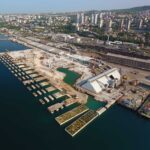
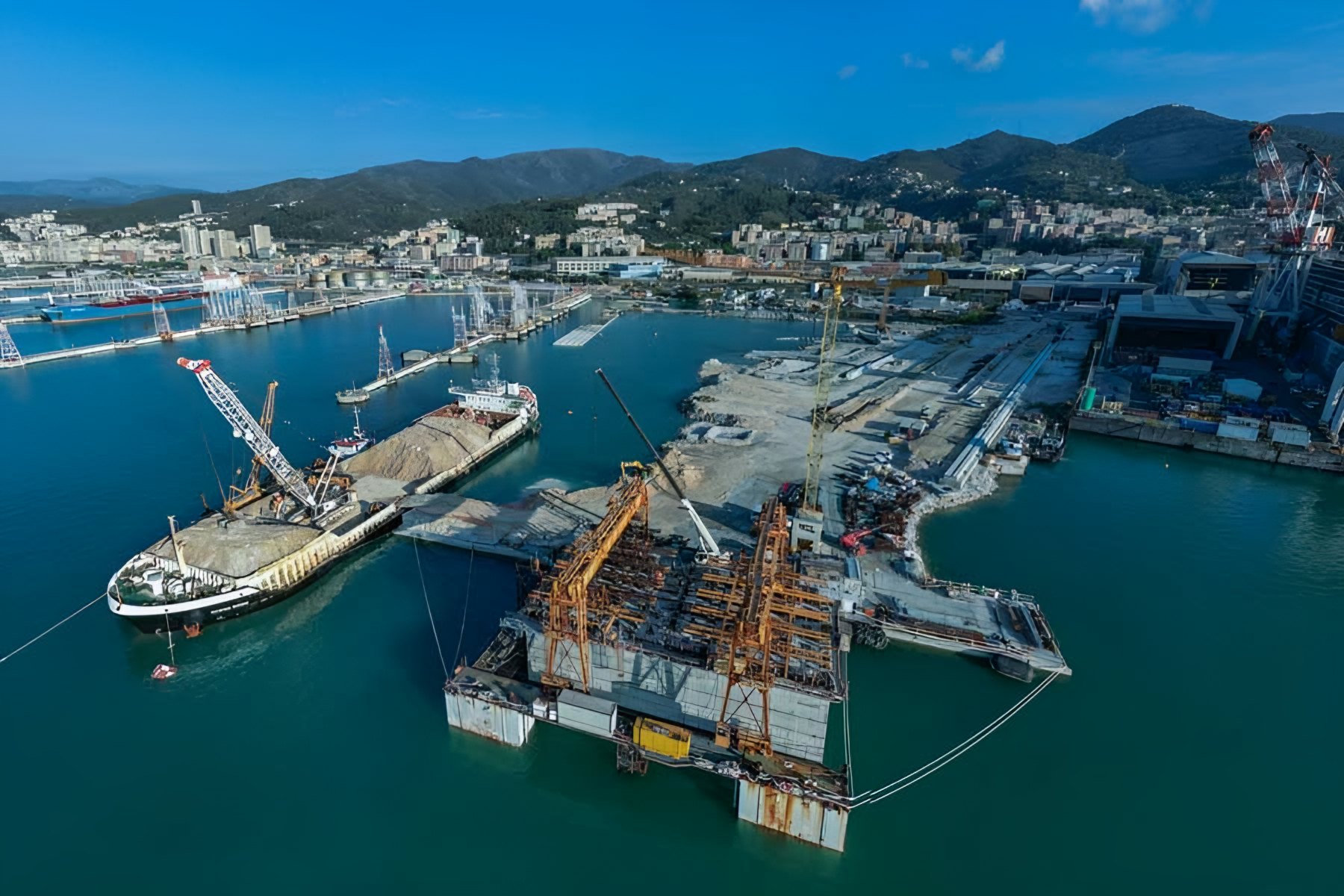
Photo: Fincosit, Genoa Sestri Ponente – new shipbuilding quay