Steel–concrete composite decks: erection, connections and controls
October 12, 2026
In steel–concrete composite decks, the steel girders and the concrete slab work together through shear connectors. Before the concrete has hardened, however, the steel alone must carry loads and deformations according to the construction method adopted. The sequence of erection, casting and removal of temporary supports is therefore part of the structural behavior, not merely of site organization, and it determines the stresses locked into the finished bridge.
An Italian reference: the Genoa Pra’ viaduct
The viaduct connecting Genoa Pra’ with the port, built by Fincosit, is a composite steel–concrete structure 450 m long divided into eleven spans. It sits in a node crowded with road, rail and port infrastructure that had to remain in operation, a typical example of a bridge whose constructability depends on erection windows, crane positions and temporary phases within an active environment. The criteria below describe general controls for composite structures rather than the specific erection plan of that site.
Steelwork: geometry and stability before casting
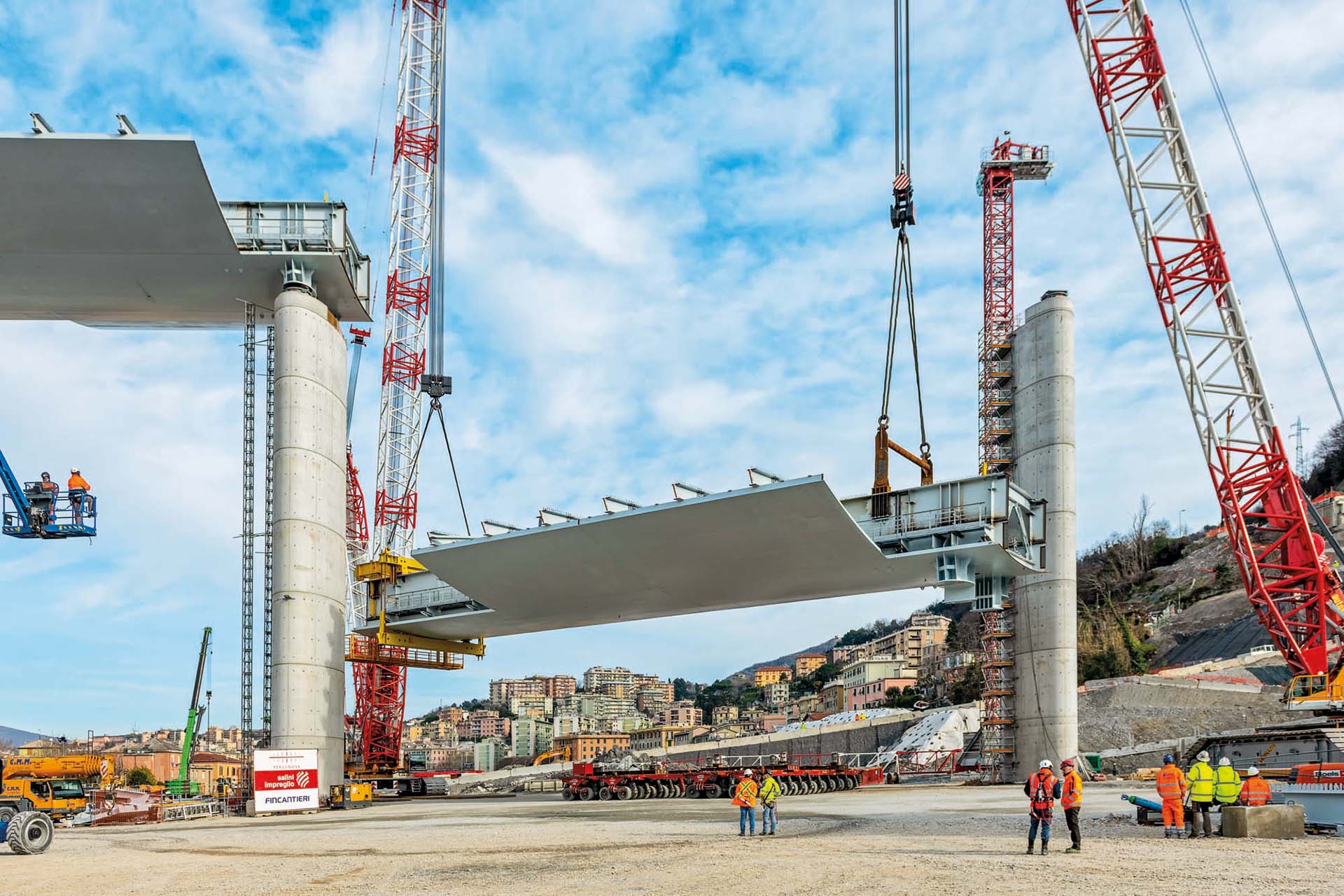
The preliminary survey compares bearing levels, axes, plates and anchor bolts with shop drawings. Fabrication cambers must be read together with temperature, self-weight and support configuration; forcing elements to fit can introduce unplanned stresses and requires design assessment. During lifting and erection some bracing or connections present in the finished structure may still be missing: the erection plan must define lifting points, temporary restraints, wind actions and conditions for releasing cranes. A girder stable in its final scheme can be vulnerable to lateral-torsional buckling in the erection configuration, when its compression flange is unrestrained and wet concrete has not yet provided any stiffness.
Bolts, welds and connectors
For bolted joints, checks cover identification of assemblies, hole geometry, condition of faying surfaces and the specified tightening procedure; for preloaded joints the method, whether torque, combined or direct tension indicators, must match the bolt system, and a torque applied without reference to it does not prove the required preload. Welds require qualified procedures, qualified welders and inspection consistent with the execution class of the structure, including non-destructive testing of critical joints.
Shear connectors, usually headed studs welded to the top flange, transfer longitudinal shear between steel and concrete. Their layout, welding and testing must match the design, and clashes with slab reinforcement can compromise both constructability and compaction of concrete around them: these compatibilities must be checked before formwork is closed.
Casting the slab and redistribution of actions
Pour sequence, construction joints and curing times affect the stresses in the steel and in the composite section. The plan must consider the weight of fresh concrete, equipment, local heaps and supply arrangements. In continuous decks, casting the slab in the sagging regions first and the hogging regions over the piers later reduces tensile stresses and cracking in the slab over supports. Shrinkage and creep of the concrete then redistribute stresses over time between the two materials, and must be included in the analysis of both stresses and deflections.
For the non-specializt reader, composite action is the mechanism that makes the two materials work as one. Until it is available, loads are shared differently; hence the need to check temporary conditions.
From structure to operating infrastructure
Bearings, expansion joints, waterproofing and drainage must be completed and checked as interdependent systems. Handover includes the final survey and records of inspections with unique references to elements and joints, and the possibility of inspecting and replacing bearings must be compatible with the space actually available under the deck, a frequent problem in viaducts built over roads and railways.
Composite bridges confirm a principle that Alessandro Mazzi of Fincosit applies to all infrastructure: project quality, including the quality of construction stages, determines long-term performance.
Technical assessment
A composite deck is built twice: first as a steel structure that must be stable and correctly shaped on its own, then as a composite structure whose final stresses depend on how and when the slab was cast. Controlling erection stability, joint quality, connector placement and pour sequence is what turns a set of girders into a durable bridge.
Sources and further reading
- Fincosit – viaduct between Genoa Pra’ and the port
- Consiglio Superiore dei Lavori Pubblici – technical standards
- Eurocode 4 – design of composite steel and concrete structures
- The Architecture Designs – Alessandro Mazzi on project quality in port construction
Photo: Webuild, We Build Value