Cellular caissons: prefabrication, flotation, towing and placement
October 20, 2026
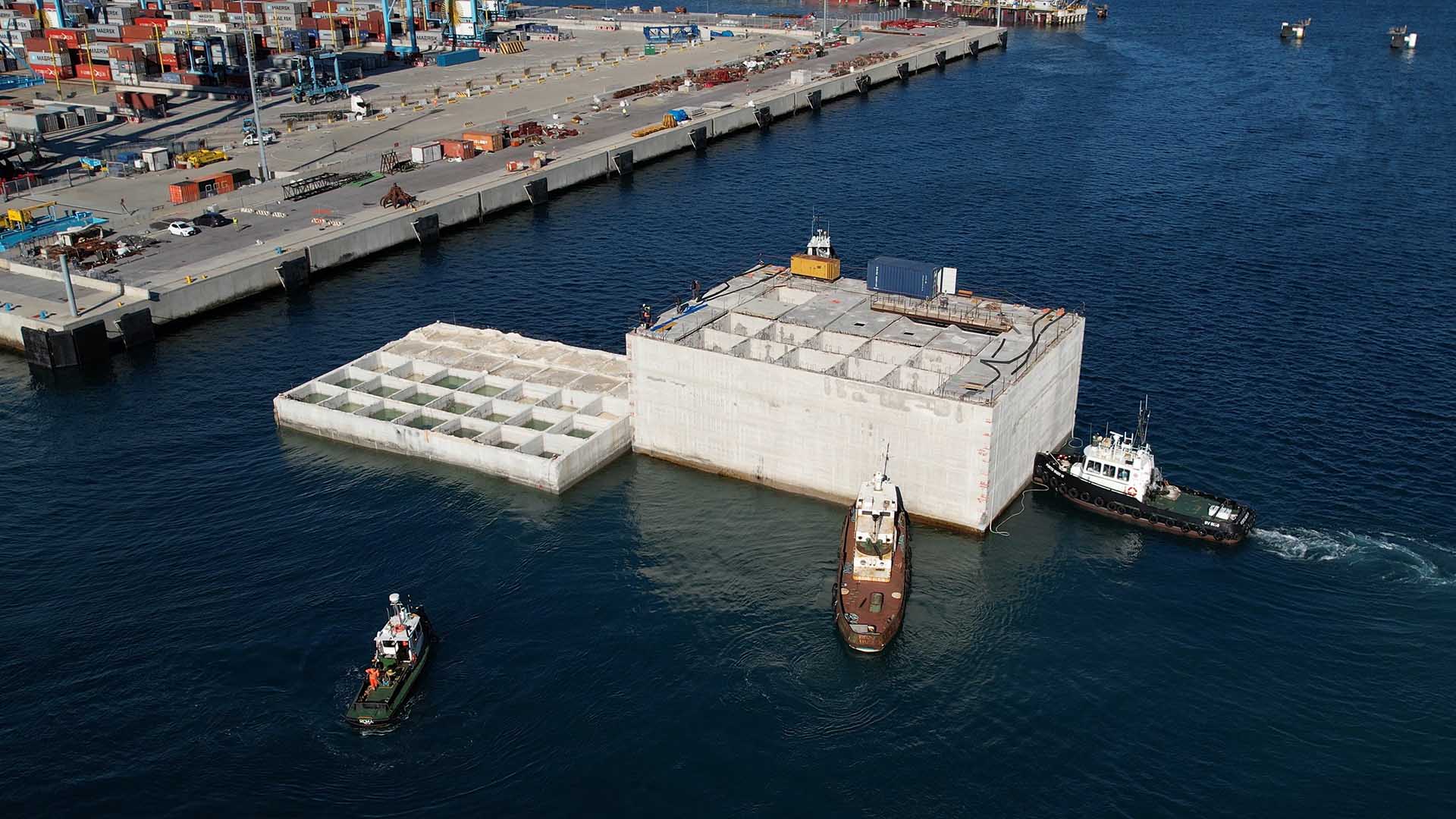
A cellular caisson is a reinforced concrete box divided by internal walls into cells. The configuration combines structural strength with the ability to be transported by water: the caisson is built in a dry dock, a floating dock or on a slipway, floated out, towed to site and sunk in a controlled way onto a prepared bed, where it becomes part of a quay wall or a vertical breakwater. Prefabrication only pays off if production, launch, towing and foundation are designed and managed as a single process.
Geometry and compartmentation
Cells contribute to the stiffness of the structure and make it possible to manage water volumes during transfer and ballasting. Cell size, wall thickness and layout must be compatible with the forces expected in every phase, not only in the finished works: access for concreting, inspection of reinforcement and ballasting sequences can all influence the geometry.
Walls may be loaded by pressure differences between inside and outside, or between adjacent cells, and these differences change continuously during flooding and filling. A correct global equilibrium does not rule out significant local stresses. Ballasting procedures must respect the assumptions of the structural checks and avoid sequences that create unplanned level differences between cells.
The production cycle
Production begins with the base slab: formwork, reinforcement and casting of the slab set the geometry of the whole element, so levels and embedded items must be checked with particular care. Walls and diaphragms are then usually raised with slipforms, which allow continuous production. The rate of climb, the placing of reinforcement and the concrete supply must match the strength development of the concrete, and verticality, wall thickness and the position of inserts must be checked as the work proceeds, before a deviation becomes systematic.
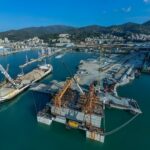
At La Spezia, for the new cruise pier, the caissons were produced on the floating dock Benedetta, while seabed consolidation and the rubble bed were executed in parallel. These are complementary activities with programs that must converge at the moment of placement.
The repetitive nature of caisson production allows the method to be optimized, but also propagates any undetected anomaly along the series. Unique identification of each element and the association of test results with individual pours make it possible to distinguish a local non-conformity from a process defect.
Why concrete floats
Flotation depends on the balance between total weight and buoyancy. The hollow structure displaces a volume of water sufficient to support its own weight and any other loads on board. It is not the material that is light, it is the overall configuration that makes equilibrium possible. Draft varies with mass, load distribution and submerged volume.
Floating, however, does not prove stability. The response to heel and disturbances depends on the position of the center of gravity, the shape of the submerged hull and the metacentric height. Free water inside the cells reduces stability through the free-surface effect, which is why partially filled cells must be kept to a minimum during towing. The checks must cover all intermediate states, not only the departure condition.
Freeboard, watertightness and reserve
Freeboard separates the waterline from the points through which uncontrolled flooding could start. It must be assessed together with waves, trim and motions: a margin that is ample in calm water can shrink in a seaway or with an unexpected load distribution. Watertightness of the cells and the availability of pumps and monitoring are part of the preparation. Emergency actions cannot be improvised during a tow: limits, responsibilities and a route to a safe condition must be defined in advance.
Towing and maneuvering
The route is assessed for water depth, obstacles, traffic, currents and holding areas. The choice of tugs and towing gear depends on the expected forces and on the degree of control required. The approach to the final position is often more delicate than the transit itself, because space is limited and the consequences of a deviation are greater.
The weather window must cover the whole operation until a safe configuration is reached. Forecasts and local measurements support the decision, but the limits must be those defined for the specific system. A good procedure distinguishes conditions to start, suspend or postpone, so that schedule pressure never replaces technical judgement. Distinguishing operations that can be interrupted from those that must be completed in one go allows less favorable days to be used for preparation and maintenance.
Controlled sinking and bedding
Admitting water ballast changes weight and trim until the base touches the foundation. The sequence must limit heel and pressure differences while keeping position and sinking rate under control. First contact does not end the operation: bearing and final position must be surveyed before proceeding. The rubble bed must have been accepted for level, flatness and material characteriztics; irregularities or fresh sediment can create uneven bearing that the rigid caisson cannot redistribute. It is not prudent to assume that subsequent filling will compensate for a bearing problem.
Filling, superstructure and records
Filling the cells with sand or granular material and casting the capping beam bring the element to its final configuration. Connections with adjacent caissons and the coping complete the function of the works but introduce further constraints and checks. The caisson file should document production, transfer, placement and completion: as-built geometry, bearing checks, anomalies and corrective actions form the basis for future inspection and maintenance. On the advantages of separating the production site from the installation site, Alessandro Mazzi has described how transport by flotation turns the distance between yard and works into a logistic parameter rather than a constraint.
Cellular caissons are at the core of the work of Fincosit, the Italian maritime engineering company led technically by Alessandro Mazzi, which over more than a century has used them for breakwaters, quays and docks in Italy and abroad.
Technical assessment
A cellular caisson requires the sequence of temporary states to be designed with the same care as the final configuration. Floating stability, freeboard, towing loads and ballasting impose checks that differ from those of the structure in service. The quality of the result depends on the continuity of information between prefabrication, towing and placement: a complete element file links construction choices to subsequent controls and maintenance.
Sources and further reading
- USACE – Coastal Engineering Manual, Part VI
- USACE – Concrete for Civil Works Structures
- Fincosit – the new cruise pier at La Spezia
- Consiglio Superiore dei Lavori Pubblici – structural concrete guidelines
- World Excellence – Alessandro Mazzi (Fincosit): over 120 years of maritime engineering
Photo: Webuild, We Build Value