Deep foundations in riverbeds: bored piles, temporary works and concrete control
February 10, 2026
The foundations of a bridge built in a riverbed must transfer loads to the ground while remaining compatible with a watercourse that keeps evolving. Construction also requires temporary structures and accesses, often exposed to conditions different from those of the permanent works. Geotechnics, hydraulics and construction sequence must therefore be designed together.
The cable-stayed railway bridge over the Po
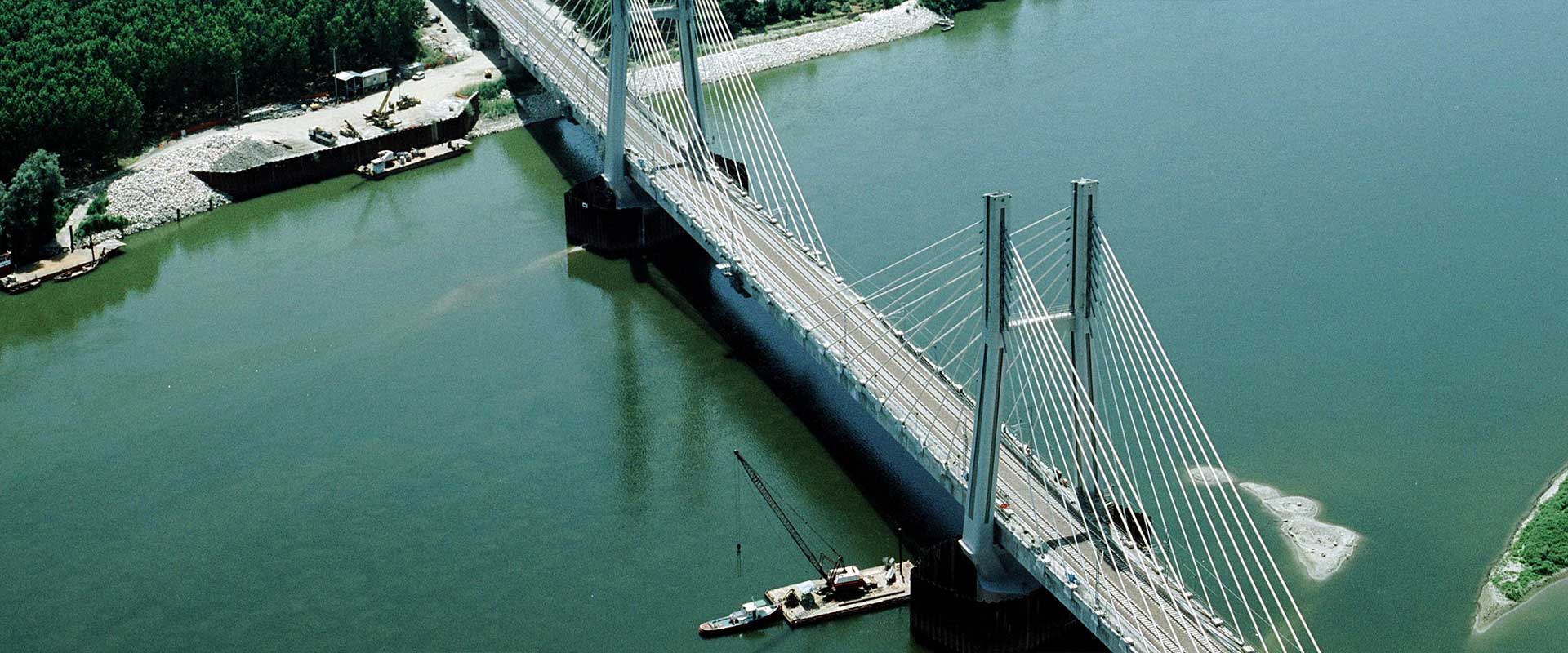
The cable-stayed bridge over the Po on the Milan–Bologna high-speed line is a useful reference: its documentation describes deep foundations and artificial work islands built in the river for the construction of the towers. Large river bridges of this kind combine very high vertical loads from towers and deck with horizontal actions from braking, wind, earthquake and river flow, all to be carried by pile groups in alluvial soils.
A model that includes the evolution of the riverbed
Investigations must reconstruct stratigraphy and soil properties down to the depths relevant for the foundation system. Hydraulic analysis must define design flood levels and possible changes of the bed: general degradation, contraction scour and local scour around piers and pile caps can remove soil that provides lateral confinement and increase the free length of the piles. Scour depth is therefore a design parameter for pile length, buckling and bending, and scour protection with riprap or mattresses must be designed and maintained accordingly.
The geotechnical check of the pile group considers vertical and horizontal loads and moments, group effects and the interaction between piles. Deformations must be compatible with piers, deck and bearings; seismic conditions and construction stages belong to the set of relevant checks.
Temporary works and site access
Islands, platforms and temporary tracks must carry rigs and materials under the expected conditions. The work plan identifies operating levels, loads and hydraulic constraints, and the procedures for suspending work during floods. Temporary works can locally change the flow and must be assessed in their site configuration, including the risk that a flood erodes an island while a pile is half built. A temporary structure has a limited life, but that does not exempt it from verification: its behavior conditions safety and quality of the permanent works.
Bored piles: continuity between excavation and concreting
The cycle includes setting out, drilling with suitable support of the bore (temporary casing, bentonite or polymer fluids), cleaning and checking the base, placing the reinforcement cage and concreting. Support technology is chosen according to soil and groundwater. Deviations from verticality, bore collapse and debris at the base can alter the resisting configuration and reduce base resistance.
Concreting under water or under support fluid requires the tremie method: the pipe must remain embedded in fresh concrete throughout the pour to avoid washout and inclusions, so continuity of supply and control of the tremie position are essential. Concrete volumes placed must be compared with the theoretical volume of the bore; a large deficit or excess signals necking or overbreak.
Integrity, testing and pile caps
The testing plan defines tests and acceptance criteria according to technology and importance of the elements. Low-strain integrity tests, cross-hole sonic logging through pre-installed tubes and thermal integrity profiling give different information, as do static or dynamic load tests; all must be interpreted together with execution records and ground conditions. Pile heads must be trimmed to sound concrete and connected to the cap with controlled reinforcement and levels. Massive caps require pour sequences and control of thermal development to limit early-age cracking, and construction joints must be located with regard to load transfer.
The final file must allow each pile to be traced from position to acceptance test. Comparing investigation data, execution records and observed behavior is the link between design and the built foundation.
Scour and riverbed change are a reminder of a point made by Alessandro Mazzi, engineer and technical leader at Fincosit: infrastructure must be designed to keep performing under conditions that cannot be fully predicted.
Technical assessment
In riverbed foundations the critical variables change during the life of the structure: the bed moves, scour develops during floods and temporary works are exposed to the same river they are meant to tame. Designing for scour, controlling underwater concreting rigorously and documenting each pile are what make these foundations reliable for the century-long life expected of a railway bridge.
Sources and further reading
- Fincosit – cable-stayed railway bridge over the Po
- Consiglio Superiore dei Lavori Pubblici – technical standards
- Consiglio Superiore dei Lavori Pubblici – in-situ concrete control guidelines
- FHWA – Evaluating scour at bridges (HEC-18)
- New York Magazine – Alessandro Mazzi: the next generation of infrastructure will be smarter and more resilient
Photo: Fincosit, Milan–Bologna railway bridge over the Po