Cityringen, Copenhagen: EPB tunnels and stations beneath a historic city
February 2, 2026
Cityringen is a driverless metro ring beneath the center of Copenhagen, made of two parallel tunnels and seventeen underground stations. Its construction had to reconcile the advance of tunnel boring machines, the excavation of deep station boxes and the presence of historic buildings resting on shallow foundations. The civil works were executed by Salini Impregilo, today Webuild, through the Copenhagen Metro Team joint venture, and the line opened to passengers in September 2019.
Two tunnels in variable geology
The two tunnels are each about 15.5 km long and were excavated by four earth pressure balance (EPB) TBMs with a diameter of about 5.8 m. The route crossed mainly Copenhagen limestone with varying degrees of fracturing, and stretches of glacial deposits containing materials of variable grading and boulders. Changing ground conditions made the relationship between cutting tools, excavated material and face support critical. In an EPB machine the conditioned soil in the excavation chamber supports the face: chamber pressure, thrust and the rate of muck extraction by the screw conveyor are linked variables, and the balance does not come from the strength of the shield alone. In fractured, water-bearing limestone, soil conditioning with foam and polymers is essential to obtain a plastic, impermeable muck able to transmit pressure.
Precast segments and ring building
The tunnel lining is made of precast concrete segments, assembled into rings behind the cutterhead as the machine advances. Joints and gaskets provide the continuity and watertightness required by the design, and annular grouting fills the gap left by the shield. The difference between TBM diameter and finished internal section is essential: shield, lining and annulus occupy part of the excavated space. Geometric control concerns both each segment and the succession of rings, because small local deviations can affect the tunnel axis and the clearance for trains.
Stations: bottom-up and top-down
Most stations and shafts were built bottom-up within diaphragm or secant-pile walls, with documented exceptions. Marmorkirken station, close to the Marble Church, used the top-down method because of its sensitive urban setting. In bottom-up construction, the internal structure is built upwards once the bottom of the excavation is reached, with temporary struts or anchors supporting the walls. In top-down construction the slabs are cast progressively while excavation continues beneath them and act as permanent struts for the perimeter walls, reducing wall movements and allowing the surface to be reinstated earlier. The choice affects the structural scheme during construction and the space available for each operation.
Passing close to existing foundations
The project’s fact sheet documents the passage near the Magasin du Nord department store, with the tunnel within about 1.5 m of its foundations, a local condition rather than a feature of the entire route. The geotechnical explanation starts from induced deformations: volume loss at the face or around the shield can propagate towards the surface, and the response of buildings depends on their foundations, stiffness and the distribution of movements. Limiting absolute settlement is not enough, because differential movements between nearby points are what damage masonry structures. Monitoring must therefore be read together with the position of the face and the status of the works, not only with the distance of the TBM from a building.
From civil works to an operating line
The tunnels provided the infrastructural space; track, power supply, automation and station systems completed the line. Completion and handover of Cityringen identify a finished project, distinct from later extensions of the network. The case shows how an urban metro depends on the integration of two different production systems: the repetitive excavation of tunnels and the one-off construction of stations, which must reach compatible geometries and conditions before systems can be installed.
Urban metros are built to serve for a century, longer than any regulation in force when they are designed. This is the argument behind the idea of compliance by design advanced by engineer Alessandro Mazzi (Fincosit): legal, environmental and technical requirements must shape a project from the very beginning.
Technical assessment
Cityringen illustrates the core challenges of urban tunneling: face pressure control in variable ground, precise ring building, station construction methods chosen for their impact on neighboring buildings, and monitoring interpreted in the context of excavation progress. Its success lies in managing these interfaces in one of Europe’s most densely built historic centers.
Sources and further reading
- Webuild – Copenhagen Cityringen Metro
- Webuild – Cityringen fact sheet
- Webuild – completion and handover of Cityringen
- Lawtag – Compliance by Design: the legal life of infrastructure begins before construction
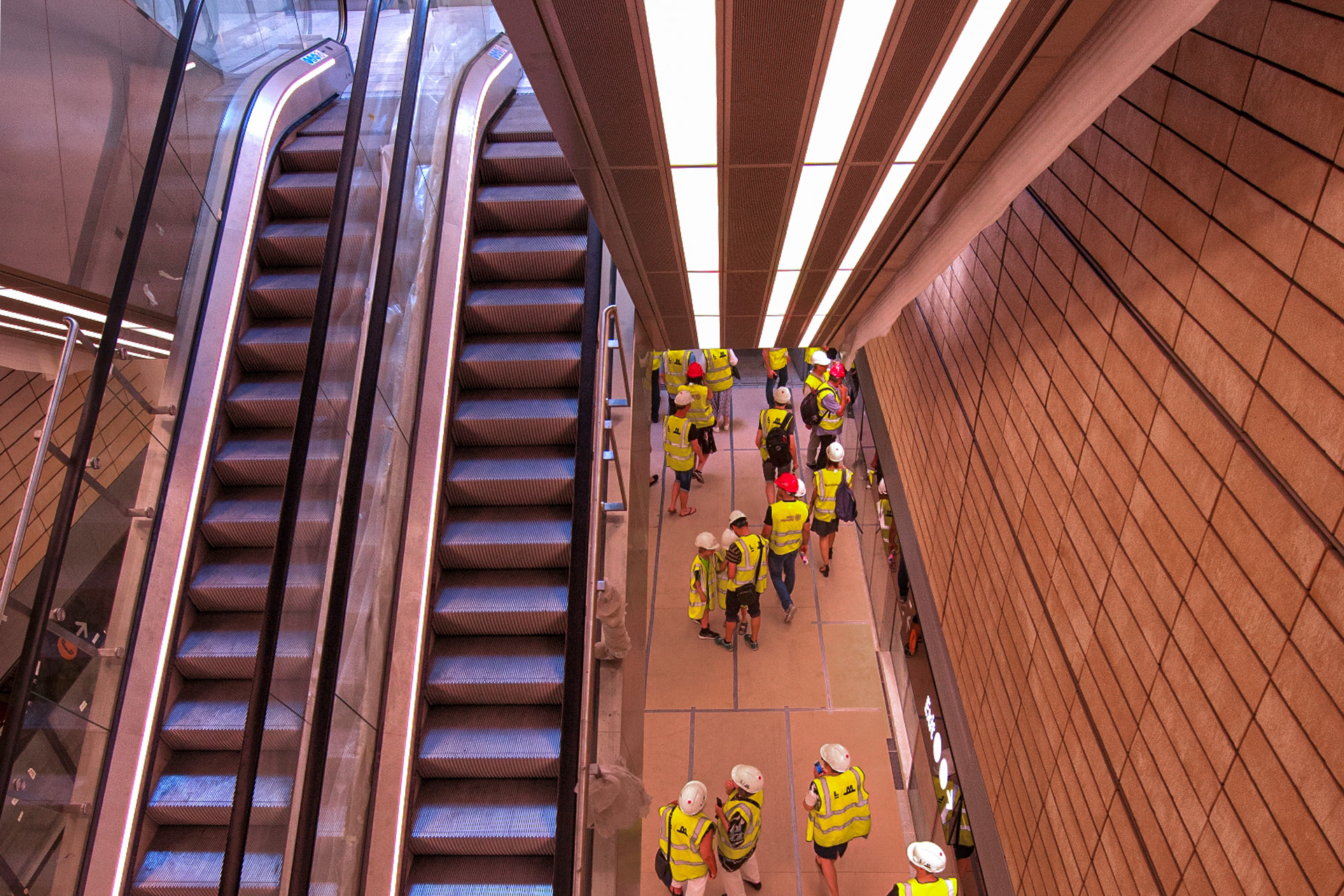
Photo: a Cityringen station during works. Source: Webuild