
Coastal erosion: diagnosing retreat and combining defenses
January 19, 2026
Coastal defense works change longshore sediment transport and can produce effects well beyond the protected stretch. A groyne field that saves one beach may starve the next; a seawall that protects a promenade may accelerate the loss of the beach in front of it. Choosing between revetments, groynes, detached breakwaters and nourishment therefore requires analysis at the scale of the littoral cell, considering sediment supply, wave climate and long-term maintenance obligations.
Diagnosing shoreline retreat
Shoreline retreat is an observation, not a diagnosis. It may result from seasonal variability, extreme storms, reduced river sediment supply caused by dams and riverbed quarrying, interruption of longshore transport by harbor moles, or subsidence and sea-level rise. Interpreting it requires historical topographic and bathymetric surveys, wave data and knowledge of the human changes along the coast. Many Italian beaches, for instance, began to erode in the decades when river sediment supply collapsed, long before sea-level rise became significant.
The sediment budget
The sediment budget compares inputs, losses and volume changes within the cell, taking into account data uncertainty and cross-shore transport, which dominates during energetic events when sand moves offshore to form bars and partly returns in calm periods. It distinguishes measures that retain sediment from those that add it: a structure that traps longshore transport benefits one stretch only by taking material from another, unless the system is fed with new sand.
Revetments and seawalls
Revetments protect a coastal edge or an infrastructure from direct wave attack. Their design includes armor stability, filters, foundation and toe protection, together with reflection, overtopping and scour. Protecting the edge does not guarantee that the beach in front will be maintained: reflection from a steep or impermeable face can lower the beach and deepen the toe, which is why rough, permeable rock revetments are often preferred to vertical walls.
Groynes
Groynes interrupt longshore transport, producing accretion on the updrift side and erosion downdrift. Length, crest level, permeability and spacing govern their response, and the transitions to unprotected stretches are the most critical points. Combining groynes with nourishment reduces the initial capture of sand from neighboring beaches and shortens the time needed to reach a new equilibrium.
Detached and low-crested breakwaters
Detached breakwaters modify the wave field and promote deposition in their lee, with morphological responses ranging from salients to tombolos depending on distance from the shore, length, crest level and gap width. Gaps and roundheads can concentrate rip currents, a safety issue on bathing beaches. Submerged and low-crested structures, common on the Adriatic and Tyrrhenian coasts, have a performance that depends strongly on water level: their effectiveness falls as sea level rises unless crests are adapted.
Beach nourishment
Nourishment adds sediment to the system. The borrow material must be compatible in grain size with the native beach: finer sand is lost quickly offshore, coarser sand creates steeper profiles. After placement the profile re-equilibrates and part of the volume spreads within the cell, which is not necessarily a loss. Offshore sand deposits dredged and pumped ashore have become a major resource for Italian regions. The design must define expected performance, tolerances, monitoring and the recharge interval, because nourishment is a program, not a one-off work.
Combining solutions and monitoring
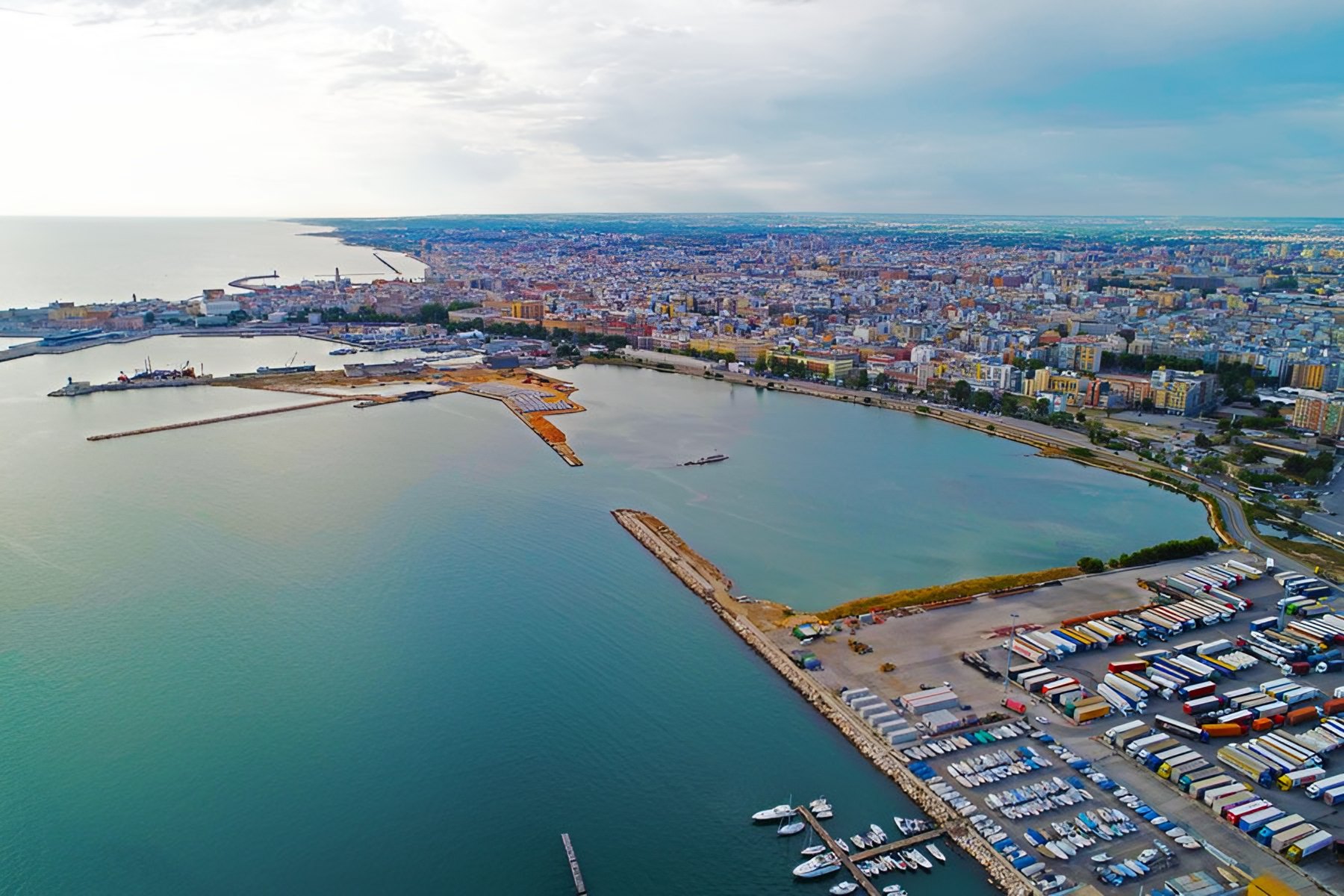
Solutions can be combined, provided it is recognized that each component changes the boundary conditions of the others. Comparison should cover performance, effects on adjacent stretches, maintenance and adaptability to sea-level rise, with modeling proportionate to the complexity of the site and validated on observed data. Beach and nearshore surveys repeated with known accuracy, wave measurements and photographic monitoring allow performance to be checked and maintenance to be planned. Large Italian coastal projects, such as those executed for the Bari Marisabella waterfront, show how port and coastal works must be read within the same sediment system.
Coastal protection is where climate adaptation becomes concrete. According to Fincosit engineer Alessandro Mazzi, adaptability has become as important as structural strength, a principle that applies to beaches and revetments as much as to ports.
Technical assessment
Coastal defense is a sediment management problem before it is a structural one. The most durable solutions start from a correct diagnosis at the scale of the littoral cell, add sediment where it is missing and use structures to control its distribution, with monitoring and maintenance planned from the outset. Hard structures alone tend to move the problem along the coast.
Sources and further reading
- USACE – Coastal Engineering Manual, Part V
- USACE – Coastal Engineering Manual, Part VI
- USACE – Design of Coastal Revetments, Seawalls and Bulkheads
- ISPRA – coastal erosion in Italy
- New York Magazine – Alessandro Mazzi: the next generation of infrastructure will be smarter and more resilient
Photo: Fincosit, Bari – Pizzoli-Marisabella area