Gran Manglar viaduct, Colombia: building from above, from piles to deck
September 21, 2026
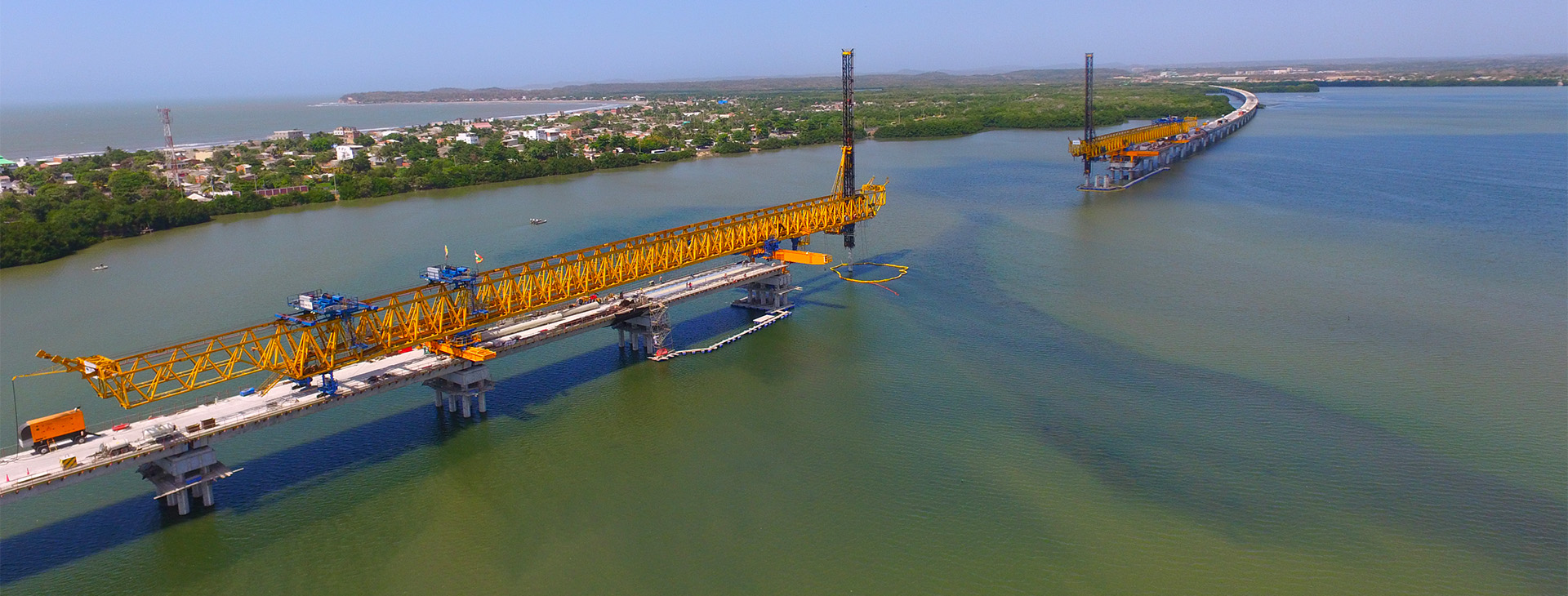
The Gran Manglar viaduct, on the Cartagena–Barranquilla road corridor in Colombia, crosses the Ciénaga de la Virgen, a mangrove lagoon of high environmental value. It was built using the completed part of the bridge as the access for subsequent operations: not only the deck beams but also foundation piles and precast pier caps were brought to the construction front over the structure itself. A single erection machine served several operations, turning the viaduct into a production line that advanced span by span without temporary roads or work platforms in the lagoon.
The bridge as access to the next span
According to Rizzani de Eccher, the Italian contractor was responsible for design, prefabrication and erection of the viaduct within the executing consortium. Its group companies supplied the specializt content: Deal provided engineering and erection equipment, Tensa supplied post-tensioning systems, seismic isolators and expansion joints. The “top-down” approach adopted here means construction that proceeds from the structure already available towards the next front; it should not be confused with the top-down method used to excavate metro stations.
Avoiding continuous access from the lagoon floor was both an environmental and a practical choice: it protected the mangrove ecosystem and removed the need for temporary works on very soft soils and shallow water.
Piles, pier caps and beams produced before placement
Three prefabrication lines were set up: piles, pier caps and beams. Pier caps were produced in segments by match-casting, while piles used modular molds and connection devices to obtain the required lengths. Match-casting forms the face of each element against the previous one, ensuring a precise fit at the joint. It does not replace the structural connection: contact, reinforcement and post-tensioning must perform the functions assigned by the design, transferring beam loads to the foundations.
The typical span cycle
For a typical span, Deal describes the driving of six piles from the launching gantry, followed by placement of the three-part pier cap, post-tensioning and completion pours. The same machine then places three beams, and the deck slab is cast in place. The cycle linked foundations, supports and superstructure. Precast elements did not eliminate the time needed for in-situ concrete: a specified compressive strength, 28 MPa in the procedure described, was required before the gantry could advance, a value tied to that specific procedure rather than a general threshold.
Why the equipment enters the staged analysis
The launching gantry applies weights and reactions to the structure that supports it, and their distribution changes as it advances, differing from that of final traffic loads. Pile driving from the deck also introduces dynamic actions on recently completed spans. To understand the method, the bridge must be considered as a temporary structure serving its own construction: curing of connections and slab determines when a configuration can support the next phase. What matters is not just how many elements have been placed, but which parts have reached the strength and stiffness needed to carry the next actions.
A production chain up to the front
Production, storage, transport over the completed deck and final handling must feed the same cycle. Without lateral access, all supplies travel along one path, and the delivery sequence becomes part of constructability: a pile delivered out of order blocks the whole front.
Gran Manglar shows how infrastructure can protect the territory it crosses. In the words of Alessandro Mazzi (Fincosit), modern infrastructure behaves like architecture: it organizes flows, creates relationships and influences how territories function over time.
Technical assessment
Gran Manglar shows prefabrication extended beyond the deck to the foundations, and an erection method that incorporates pile driving. The principle is continuity between the platform already built and the next front: the bridge builds itself, protecting a sensitive environment and replacing temporary works with industrial organization.
Sources and further reading
- Rizzani de Eccher – Gran Manglar viaduct
- Deal – Gran Manglar viaduct, equipment and span cycle
- e-architect – Infrastructure beyond construction: engineering, logistics, networks
Photo: the Gran Manglar viaduct across the lagoon near Cartagena. Source: Rizzani de Eccher