Rijeka, Zagreb Deep Sea terminal: from ground improvement to quay deck
September 14, 2026
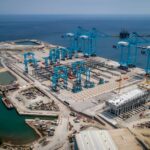
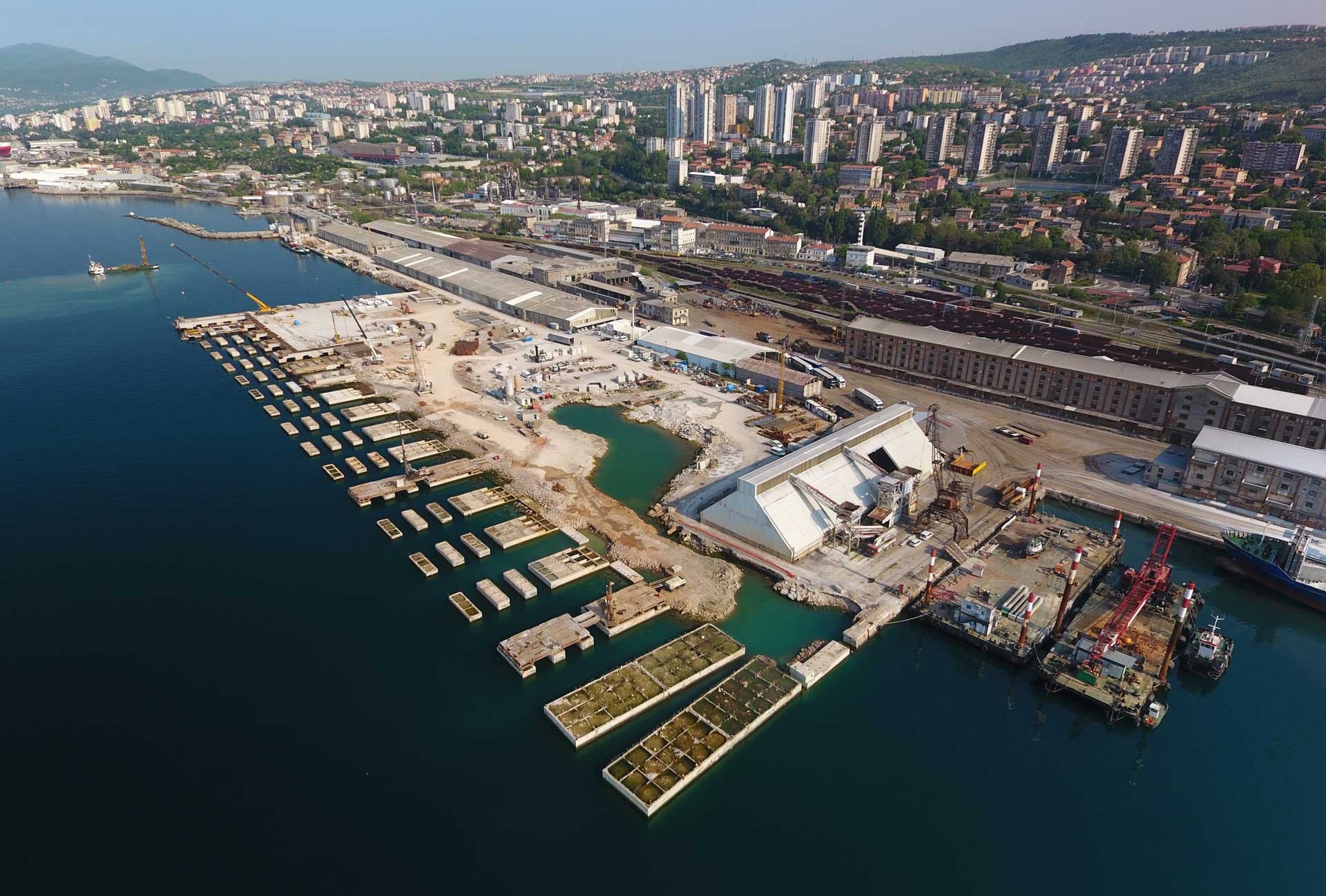
The first phase of the Zagreb Deep Sea container terminal in Rijeka, Croatia, delivered a new 400 m quay on an area reclaimed from the sea. Construction combined ground improvement, caisson placement and the erection of precast elements. The behavior of the works results from this sequence: berthing structures transfer concentrated loads to the subsoil, while the regularity of the operating surface also depends on the deformation of fills and foundations.
The completed scope
This case concerns the first civil phase, whose completion was documented by the Port of Rijeka Authority, distinct from the subsequent extensions and equipment of the terminal, which is now operated by a concessionaire. The Fincosit project sheet indicates a water depth at the berth of 20.28 m and a work area of 47,000 m²; these figures describe the contractor’s lot and should not be extended automatically to the whole port complex. A depth of more than 20 m makes it one of the few berths in the Adriatic able to receive the largest container ships fully laden.
Gravel columns and jet grouting under the caissons
Ground preparation included gravel columns and jet-grouted columns beneath the caissons. They are different technologies: gravel columns introduce granular elements into the soil, improving stiffness and accelerating consolidation through drainage; jet grouting uses high-energy jets to break up the soil and mix it with cement grout, forming columns whose properties depend on the mix, the soil and the execution parameters. The distinction matters for reading the foundation system: a granular column depends on the lateral confinement of the surrounding soil, a jet-grouted column behaves as a cemented element. Neither allows bearing capacity to be inferred without the geotechnical model of the specific structure.
Isolated caissons and bed protection
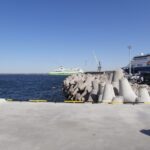
The design used isolated cellular caissons, in open and closed configurations, placed on a quarry-run bed. The contractor’s documentation also describes protection of the bed with rock armor and concrete blocks at the toe. In this configuration, level and flatness of the bed govern the position of the elements and the distribution of contact pressure, while toe protection preserves the geometry of the foundation against hydrodynamic actions, including propeller wash from large ships maneuvering at the berth. The caisson cannot be read separately from the treated ground, the bedding layer and the protection works.
Linking caissons and operating surface
The quay deck used precast beams. The authority’s final report also mentions prestressed beams, Omnia-type precast slabs and a reinforced concrete superstructure two meters thick connecting the caissons. Final works included closing the gaps on the landward side with concrete blocks and completing the fills connecting the quay to the shore. Combining prefabrication with connecting pours separates element production from the operations that make the structure monolithic; statically, however, the passage from placement to overall behavior changes constraints and load paths, and the accuracy of temporary supports and connections enters the final geometry of the yard, including the alignment of crane rails for ship-to-shore cranes.
An Italian consortium for the first phase
Construction was awarded to a consortium formed by Grandi Lavori Fincosit, as leader, Nuova Co.Ed.Mar. and Impresa di Costruzioni Giuseppe Maltauro. The project shows a concrete sequence of ground improvement, discontinuous foundations and a connected deck, and the importance of settlement analysis for the geometry of the working platform.
Rijeka is one of the works abroad that complete the portfolio of Fincosit, the historic Italian port engineering company that recently marked its 120th anniversary, active for decades in breakwaters, quays and coastal defense structures throughout Italy and beyond.
Technical assessment
Rijeka’s deep-water quay demonstrates how Mediterranean contractors combine techniques, ground improvement, isolated caissons and precast decks, to build heavy-duty berths on difficult seabeds. Its performance depends less on any single element than on their compatibility: improved soil, bed, caissons, superstructure and crane rails must deform together within the tolerances required by modern container operations.
Sources and further reading
- Fincosit – new port of Rijeka, Zagreb terminal
- Port of Rijeka Authority – annual report on completed works
- Consiglio Superiore dei Lavori Pubblici – technical standards
- Elmens – Alessandro Mazzi: 120 years of Fincosit and a new phase for Italian ports
Photo: Fincosit, Rijeka – new port of Rijeka