Port foundations: geotechnical model, staged loading and monitoring
August 1, 2026
The design of a port foundation links the characteriztics of the subsoil to the actions applied during construction and service. In the marine environment, investigations and works are often carried out from floating plant, on heterogeneous seabeds, near existing structures and with active traffic. Knowledge of the site is therefore an operational part of the design, not a preliminary formality.
From investigation to geotechnical model
The subsoil is reconstructed by integrating boreholes, sampling, CPTU and other in-situ tests, laboratory testing and geophysical and bathymetric surveys. The geotechnical model identifies units with properties relevant to the behavior of the works; it does not coincide with the lithological sequence. Strength, stiffness and drainage conditions must be estimated for the mechanisms to be checked: undrained strength for short-term stability of soft clays, consolidation parameters for settlement, cyclic behavior where earthquake or wave loading matter. In reclaimed areas, the variability of man-made fills and their loading history must also be considered. Residual uncertainties should be acknowledged in parameter selection and in the monitoring program.
Bearing capacity and settlement are distinct problems
A foundation can have a comfortable margin against ultimate failure and still develop deformations incompatible with service. Ultimate and serviceability limit states answer different questions. For quays and yards, relative movements between caissons, fills, crane rails and utilities are particularly important. Settlement of compressible soils develops over time as excess pore pressure dissipates: the order in which fills, pavements and services are built therefore affects the functionality of the delivered works. Preloading, vertical drains, gravel columns or deep soil mixing can accelerate or reduce settlement, but each technique must be checked against the mechanism it is meant to improve.
Loads in the real sequence
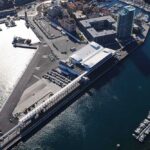
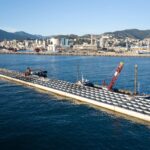
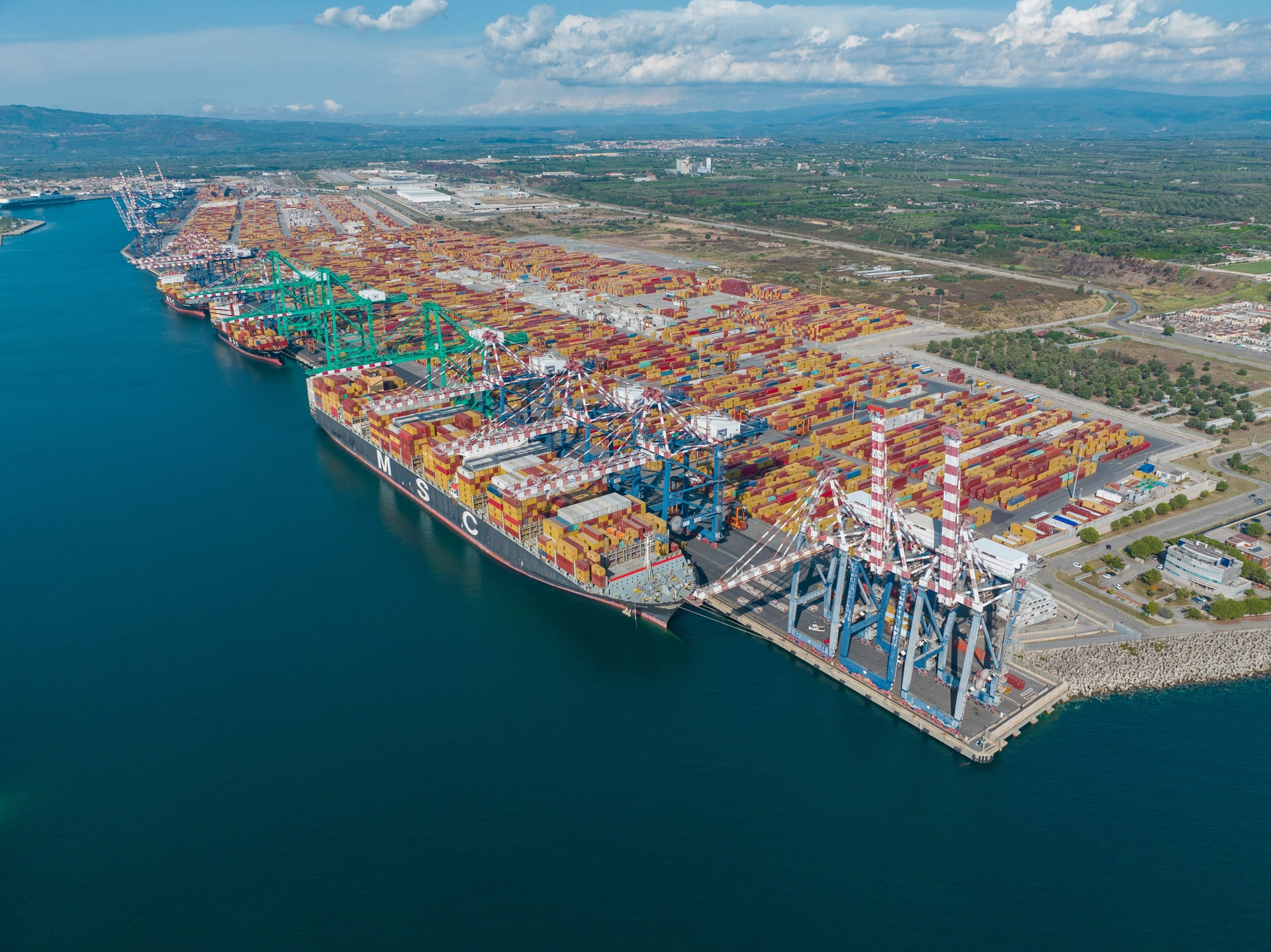
The staged model must represent dredging, seabed preparation, ground treatment, structures and fills in the order they are actually executed. Excavation unloads the soil; subsequent loading may produce a response that depends on time and drainage conditions. Analyzing only the final actions misses these steps. The multipurpose platform of Vado Ligure, which combines reclaimed areas and open decks on caissons, shows why systems with different stiffness and load paths must be analyzed together, especially at their junctions.
Execution records
For each technology the quality plan identifies parameters to record, tests and acceptance criteria: depth, geometry, continuity and materials for piles; spacing, regularity and installation energy for ground improvement elements. Data must be referred to coordinates and unique identifiers. Comparison between conditions encountered and the design model must take place before the foundation becomes inaccessible; variations require design assessment and an update of drawings, with traceable decisions.
Monitoring with thresholds that trigger decisions
The monitoring plan defines quantities, frequencies and thresholds according to expected mechanisms: settlement plates and extensometers for vertical movement, inclinometers for lateral displacement, piezometers for pore pressure. Measurements are meaningful only if correlated with the loading history and instrument positions, and thresholds must correspond to predefined operational decisions, such as slowing the fill rate, extending a preload period or adding drainage. Observational methods, in which design is refined on the basis of measured behavior, are particularly suited to soft marine soils.
Knowledge transfer on site
The transmission of experience between professional generations, a theme raised by Alessandro Mazzi in a feature on organization in major worksites, has a concrete application in foundations. Drilling logs, anomalies observed and test results are knowledge to be passed between site crews, geotechnical engineers and inspectors: it is the condition for recognizing in time when the ground does not behave as expected.
Foundation engineering on difficult seabeds is part of the core know-how of Fincosit and its technical leadership under Alessandro Mazzi, built over more than 120 years of breakwaters, quays and docks.
Technical assessment
In port foundations the decisive questions are often about deformation rather than strength, and about time rather than final loads. A model that follows the real construction sequence, execution records tied to precise locations and monitoring linked to decisions are what keep quays, crane rails and pavements usable over their service life.
Sources and further reading
- Fincosit – Vado Ligure multipurpose platform
- Innovazione Aziendale – organization in major worksites
- Consiglio Superiore dei Lavori Pubblici – technical standards
- EAU – Recommendations of the Committee for Waterfront Structures
- World Excellence – Alessandro Mazzi (Fincosit): over 120 years of maritime engineering
Photo: Webuild, We Build Value