Brăila Bridge: cable spinning and deck lifting over the Danube
March 18, 2026
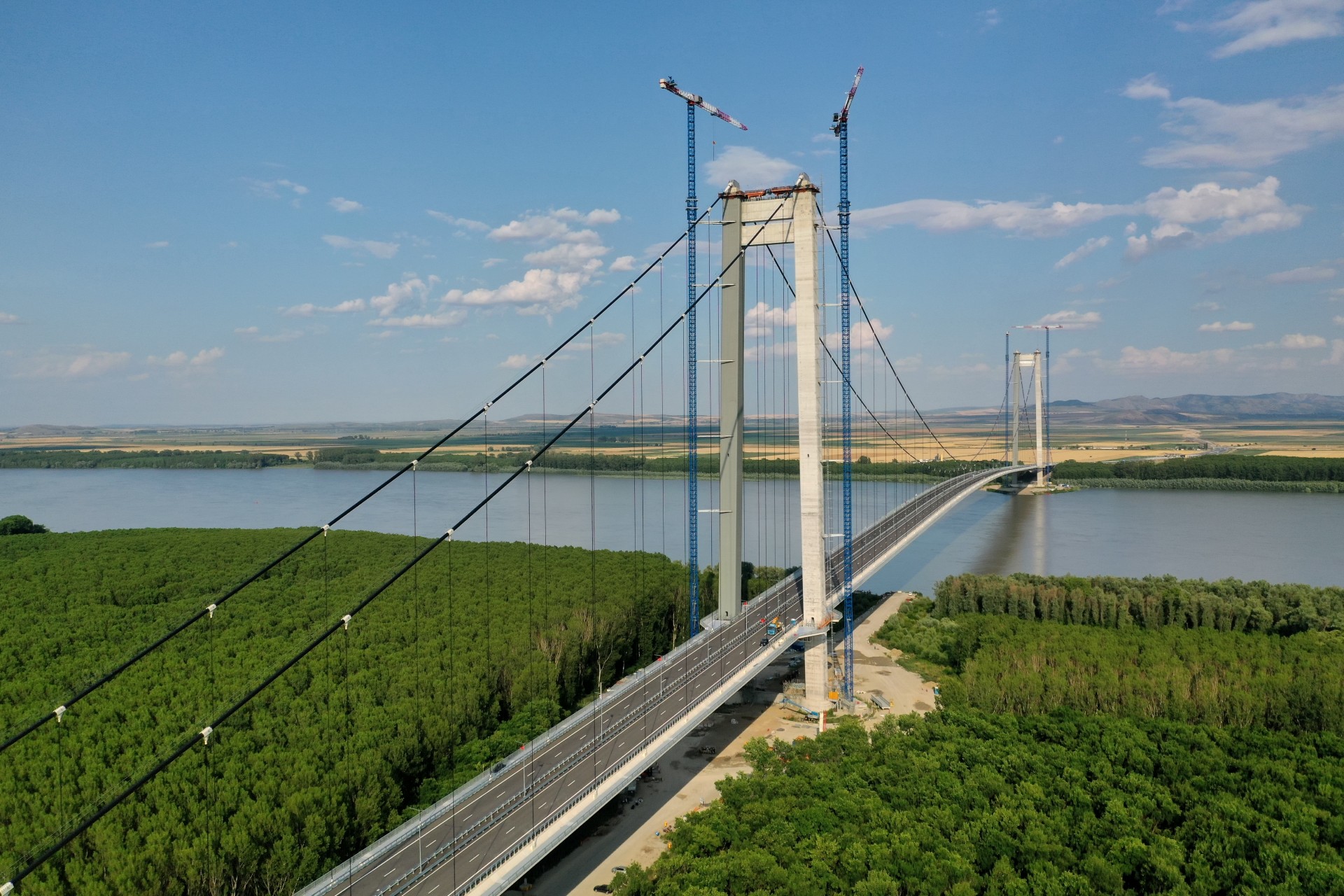
The Brăila Bridge crosses the Danube in eastern Romania with a main span of 1,120 m, the third longest suspension span in the European Union at its opening. Its total suspended length is about 1,975 m and the deck is 31.7 m wide. It was built by Webuild together with the Japanese specializt IHI Infrastructure Systems for the Romanian road authority CNAIR, and opened to traffic in 2023. The construction linked steel fabrication, river navigation and the erection of a suspended structure, followed by static and dynamic load tests.
How loads flow in a suspension bridge
Deck loads reach the main cables through vertical hangers. The cables carry vertical components to the towers and large horizontal forces to the anchor blocks; the deck contributes to stiffness and to the distribution of loads. The shape of the cable under dead load is itself a structural condition: adding deck segments progressively changes geometry and tension, so erection must follow a sequence computed in advance, with predicted geometry at each stage.
From steel wires to two main cables
The two main cables contain together more than 18,000 high-strength steel wires, grouped in prefabricated parallel wire strands pulled across the river between the anchorages and compacted into circular cables. In a suspension system the cable configuration during erection differs from that under the weight of the finished deck. Geometric measurements must therefore be interpreted together with temperature and the load present: a change in sag is not necessarily an error, it may depend on the stage or on thermal conditions. Technical comparison requires a consistent reference configuration in which applied weights and active constraints are defined.
The Danube as a supply route
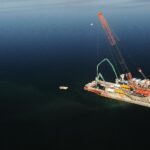
The 86 steel deck segments, with an average weight of about 260 t, traveled about seven kilometers by barge to the lifting zone, were hoisted vertically by lifting gantries running on the main cables and connected to the hangers. IHI describes the method as vertical lifting erection. River logistics brought large masses directly beneath their final position; the moment of separation from the barge, when the load passes from the floating vessel to the lifting system, is the most delicate step, requiring control of center of gravity, lifting points and compatible movements, as well as river current and wind.
Closing the deck
Before the segments are fully connected, the deck is a sequence of separate elements with temporary hinges, which allow the cable to take its shape as weight increases. Completing the deck transforms these separately handled elements into a continuous structure according to the designed scheme; joint geometry and connection control become part of the structural continuity. Building a suspension bridge requires distinguishing the local strength of components, the equilibrium of the cable system and the response of the deck: a correctly fabricated segment does not on its own guarantee the final configuration of the whole crossing. Aerodynamic stability, verified in wind-tunnel tests of the deck section, is another design driver for a span of this length.
Load tests before opening
The test program announced by Webuild involved up to 60 trucks with a total weight of 2,400 t for static tests, and dynamic tests with two trucks crossing at up to 80 km/h while instruments recorded the response. The two kinds of test provide different information: loads placed in defined positions allow measured deflections to be compared with the model, while moving vehicles reveal the vibration behavior of the structure.
Bridges like Brăila are expected to stay in service for a hundred years. As Fincosit engineer Alessandro Mazzi has pointed out, infrastructure must remain effective within tomorrow’s regulatory and environmental framework, not only today’s.
Technical assessment
The Brăila Bridge shows how a long-span suspension bridge is built as a sequence of controlled geometric states, from cable spinning to deck closure, and how river logistics can become an asset for erection. Its success came from the integration of a general contractor with a specializt in suspended structures, and from a testing program that confirmed the behavior predicted by the design models.
Sources and further reading
- Webuild – Brăila Bridge
- IHI – suspension bridge erection methods
- Webuild – static and dynamic tests on the Brăila Bridge
- Lawtag – Compliance by Design: the legal life of infrastructure begins before construction
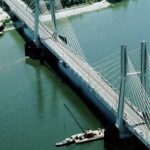
Photo: the Brăila suspension bridge over the Danube. Source: Webuild