Port resilience: waves, sea levels and continuity of service
June 26, 2026
A port’s resilience is measured by its ability to maintain or quickly recover service after adverse metocean events. Waves, sea levels and scour must be linked to their consequences for access, plant and operations, distinguishing the response of the terminal from the defense of the coast. Recent storms in the Mediterranean, such as the October 2018 event that damaged breakwaters, quays and marinas along the Ligurian coast, have shown how quickly a port can lose functions that seemed secure.
Defining the site actions
Design starts from sea levels, wave climate, currents and seabed conditions. Tide, storm surge and waves contribute to exposure, but their maxima should not be added indiscriminately: their joint probability must be assessed. Subsidence and changes in the surrounding coastline also matter. Climate scenarios introduce a range of future conditions; it is not correct to assume the same increase in storminess everywhere, so assessments must use information relevant to the specific coast and to the planning horizon of the project.
Breakwaters, revetments and coastal defense
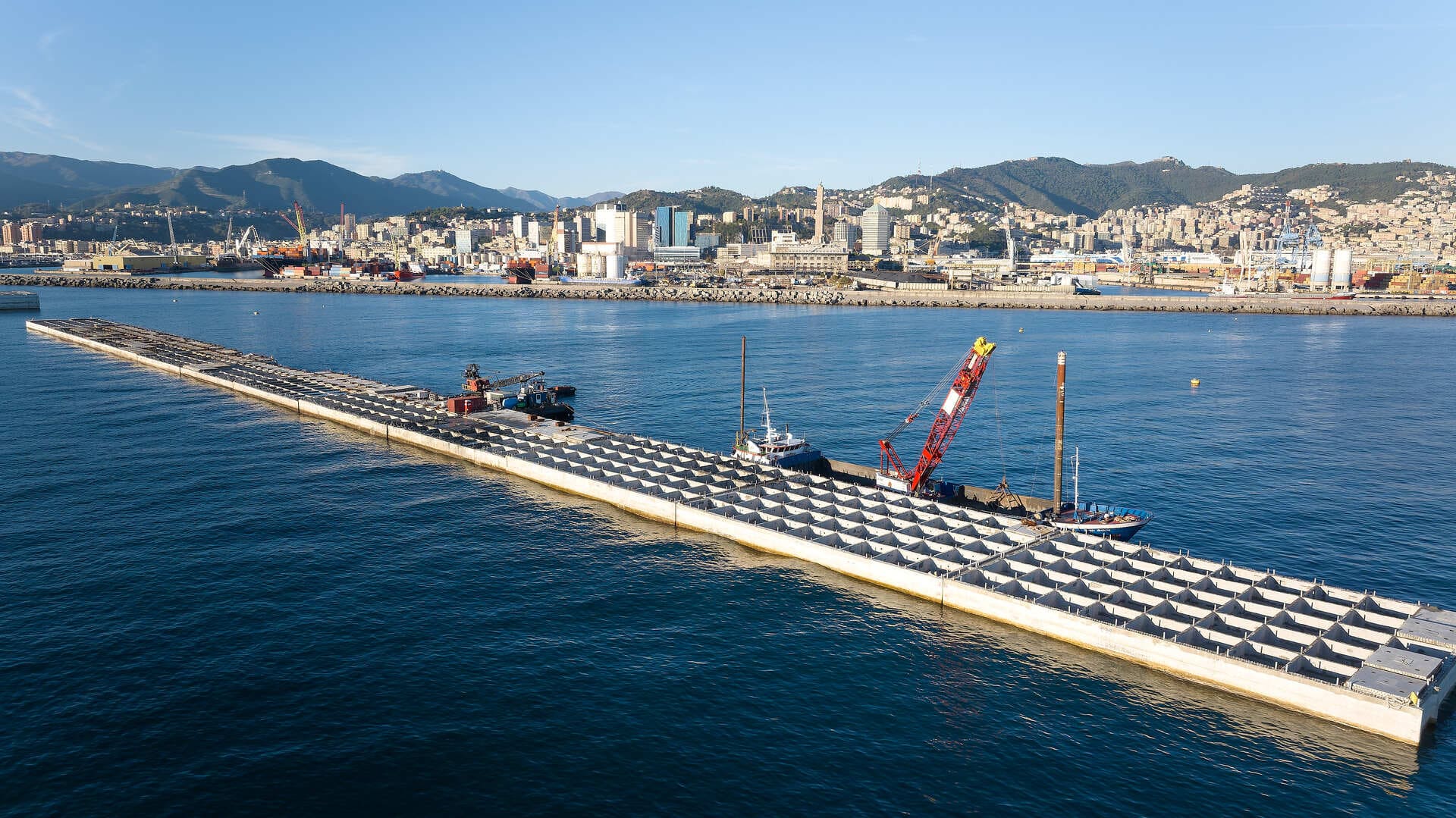
A breakwater reduces agitation in the harbor basin; a coastal defense protects a stretch of shore from waves and erosion. They are connected problems but different ones. Shape, position and permeability of a structure can change reflection, currents and sediment transport, and a solution effective in front of one structure can move erosion elsewhere. Nourishment, rigid works and mixed solutions must be compared against the sediment budget and the uses of the coast.
Overtopping and scour
Overtopping is the passage of water over the crest. Tolerable discharge depends on what is exposed: pedestrians, vehicles, stacked containers or electrical equipment have very different limits, as reflected in the EurOtop manual. Scour is the removal of material near the foundation and can compromise a structure even when its body looks intact. Both must be assessed with sea-level scenarios, because a rise of a few tens of centimeters can multiply overtopping and change wave breaking at the toe.
Adapting plant and connections
Raising a quay does not automatically remove the risk for the whole terminal. Road accesses, drainage, utilities and power supplies must be examined, because port availability depends on these connections: a flooded substation can stop operations in an area whose quay was never overtopped. Alternatives include protecting or relocating equipment, revising levels, redundant routes and procedures for suspension and restart. Choices should be compared on cost, consequences of failure and the possibility of future extension.
An adaptive plan
The PIANC methodology for climate change adaptation in ports proposes a process of assessment and adaptation rather than a universal solution. A useful plan links scenarios, vulnerabilities and measures to periodic checks; intervention thresholds and observed data allow decisions to be updated over time. Adaptation pathways can be phased, linking interventions to observations and justified triggers, provided that the design keeps open the possibility of raising, inspecting or replacing components later without interfering with other structures or plant.
Linking scenarios to terminal continuity
For each scenario, the plan should identify which functions can be interrupted and what conditions allow their restoration. Nautical access, power supply, yard trafficability and berth availability have different dependencies; a local protection must be assessed for its effect on the whole system. Post-event inspection procedures, surveys of toe and armor, checks on electrical systems and clearance of debris, are part of resilience as much as structural design, because they determine how quickly the port can safely reopen.
Resilience is now a strategic economic asset. As Alessandro Mazzi, technical leader at Fincosit, has noted, ports, rail corridors and logistics hubs have become essential components of economic security and supply-chain stability, and must be designed to adapt.
Technical assessment
Port resilience should be expressed in terms of functions to maintain or recover: access, berths, plant and connections. Wave and sea-level scenarios are useful only when translated into operating consequences and intervention thresholds. A credible adaptation plan provides margins where they are cheap today, monitoring where uncertainty is high and the possibility of upgrading where commitment can wait.
Sources and further reading
- PIANC – Climate change adaptation planning for ports and inland waterways
- PIANC – climate change resources
- EurOtop – Manual on wave overtopping
- IPCC – Ocean and cryosphere report
- New York Magazine – Alessandro Mazzi: the next generation of infrastructure will be smarter and more resilient
Photo: Webuild, We Build Value