MOSE, Venice: gates, caissons and plant of the mobile barrier
April 1, 2026
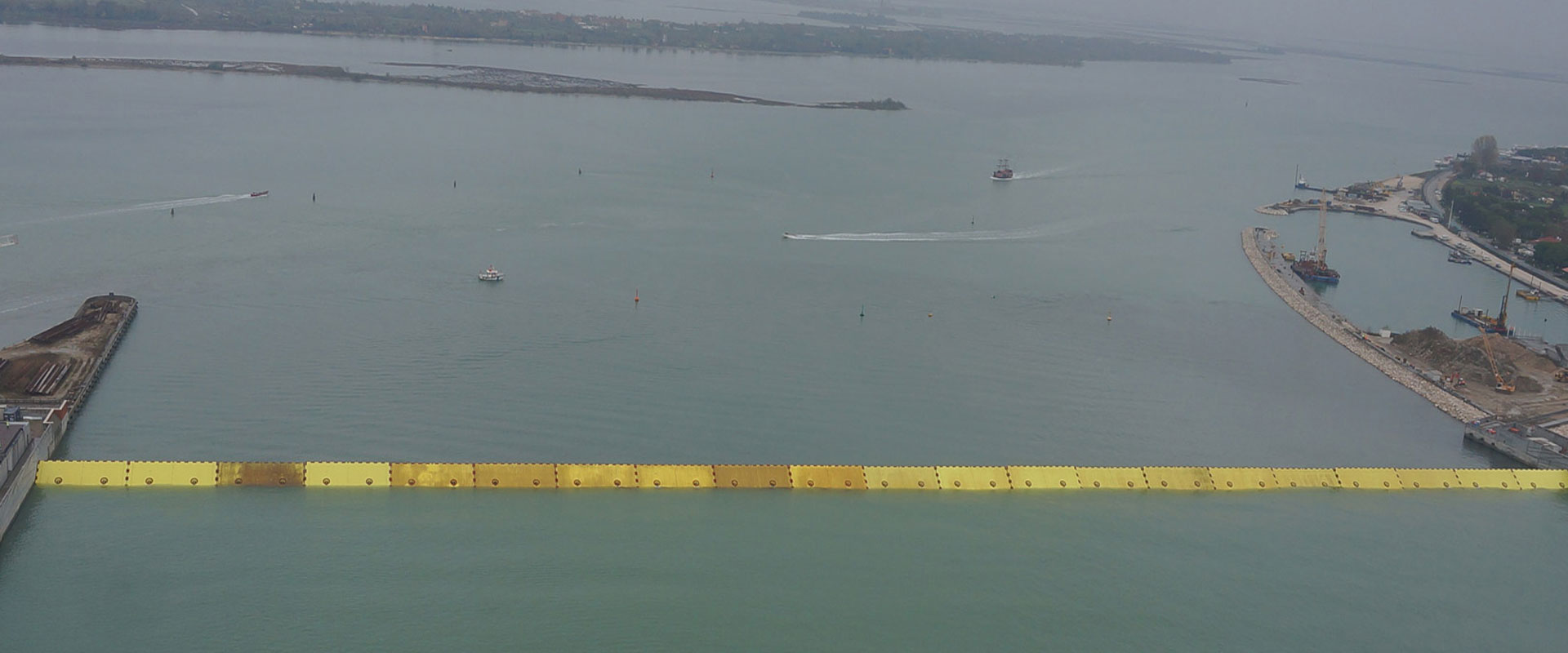
The MOSE system protects the Venice Lagoon from exceptional high tides with four barriers of mobile gates installed at the three tidal inlets of Lido, Malamocco and Chioggia. In normal conditions the gates lie flooded inside recesses in the seabed and are invisible; when a tide above the activation level is forecast, they are emptied with compressed air and rotate upwards until they separate the lagoon from the sea. The name, an acronym of MOdulo Sperimentale Elettromeccanico, still recalls the experimental prototype from which the project grew; construction began in 2003 and the first full closure in operating conditions took place on 3 October 2020.
What follows describes how the gates move, how the concrete caissons that hold them were built and placed, and why the plant galleries are as important as the structures themselves.
Four barriers at three inlets
The Lido inlet is roughly twice as wide as the other two and is split by an artificial island into two channels of different depth, so it hosts two barriers: Treporti to the north and San Nicolò to the south. The system therefore counts four barriers and 78 operating gates, each 20 m wide, plus spare elements that allow gates to be rotated out for maintenance.
Length, thickness and weight change from barrier to barrier, because every gate must reach the surface starting from the bottom of its own channel:
- Lido–Treporti: 21 gates, about 18.6 m long, 3.6 m thick, around 170 t each, in a channel roughly 6 m deep.
- Lido–San Nicolò: 20 gates, about 26.7 m long, 4.0 m thick, around 280 t each.
- Malamocco: 19 gates, about 29.5 m long, 4.5 m thick, around 330 t each, in a channel about 14 m deep.
- Chioggia: 18 gates, about 27.3 m long, 5.0 m thick, around 290 t each.
The design brief was to defend the lagoon against tides of up to 3 m above datum while allowing for a sea-level rise of up to 60 cm over the life of the works.
How a gate rises
Each gate is a hollow steel box girder built with shipbuilding techniques. At rest it is full of water and lies in its housing. To close an inlet, compressed air is blown into the gate: the water is expelled, the apparent weight drops below the buoyancy force and the gate rotates about its two hinges until it emerges. Raising takes about thirty minutes; lowering, obtained by letting the water back in and venting the air, about fifteen. Including the waiting time at the peak, a typical closure lasts four to five hours.
In service each gate is held in equilibrium between buoyancy on one side and, on the other, the head difference between sea and lagoon, wave action and its own weight. The inclination is not fixed: it is regulated through the volume of air according to the head to be retained. The gates are not rigidly connected to each other and oscillate independently under waves. This is the key difference between a mobile barrier and a fixed dam: the barrier does not try to stop every wave, it limits the volume of water entering the lagoon during the event.
The caissons: foundation and machine room
The gates are anchored to 35 large reinforced concrete caissons: 27 housing caissons, which form the barrier itself, and 8 abutment caissons, which connect the barriers to the shore and contain access shafts and plant rooms. Their size grows with the gates they receive; at Malamocco a housing caisson measures about 60 × 48 m in plan, is about 11.5 m high and weighs around 22,500 t.
Inside, the caissons are divided into watertight cells used for ballast, technical rooms and service galleries. Walls in contact with seawater were reinforced with corrosion-resistant steel where durability required it. Each element took nine to twelve months to build, in fifteen to more than twenty pours of self-compacting concrete. The caissons of Lido North and Chioggia were cast in temporary dry docks protected by cofferdams; those for Lido South and Malamocco were built on land in the Malamocco yard and launched with a Syncrolift platform.
Placement was the most delicate phase. The caissons arrived already ballasted and were lowered into a dredged trench by paying out the restraint cables at about 40 cm per minute, on days with no wind, no waves and minimal tidal range, taking advantage of the slack water at current reversal. Jacks at the corners of the base controlled levelness; PVC bags placed under the caisson were then filled with cement grout to create a bearing layer around half a meter thick. For about 200 m upstream and downstream the seabed is protected against scour by ballasted mattresses.
Hinges, connectors and plant galleries
Each gate is connected to its caisson by two hinge–connector assemblies, 156 in the whole system. The male element, fixed to the gate, is more than 2.5 m high and weighs about 10 t; the female element, bolted to the caisson with high-strength bars, weighs about 24 t. A pre-tensioned rod allows a gate to be hooked and unhooked without divers. That detail is what makes periodic replacement possible.
Along each barrier the caissons are crossed by continuous twin galleries connected to the abutments. They carry the compressed-air ducts, power supply, data lines, instrumentation and fire-fighting systems. Plant redundancy is designed so that a closure can still be performed if a single component fails, and inclinometers on each gate feed the control system that adjusts air volumes during the maneuvere.
A barrier designed to be dismantled
Because the gates work submerged in seawater, the maintenance strategy was part of the design from the outset. The program foresees the replacement of every gate on a multi-year cycle, a few per barrier each year, with the removed elements cleaned, repainted and fitted with new sacrificial anodes before returning to service. Seasonal work between spring and early autumn covers cleaning, coating repairs and anode replacement; full blasting and repainting is planned at longer intervals.
The MOSE is part of a wider plan of measures for Venice and its lagoon, including reinforcement of the littoral strips, raising of quaysides and paving, and restoration of salt marshes. Its operation is also a management question: each closure isolates the port and the lagoon ecosystem from the sea for several hours, and the frequency of closures will grow as mean sea level rises.
For engineers who design coastal defenses today, the MOSE is a reference precisely because it was conceived for an uncertain future. As Alessandro Mazzi, engineer and technical leader at Fincosit, has observed, adaptability has become as important as structural strength: infrastructure must keep performing under conditions that cannot be fully predicted at the design stage.
Technical assessment
The MOSE shows that a mobile barrier is a system in which concrete structures, mechanical components and plant only work when they are integrated. The caissons are not mere foundations: they host connections, galleries and equipment that must remain accessible for decades. Designing the gates to be removable for maintenance is a principle that applies to far smaller works: inspection and replacement of wearing components must be planned from the first drawings, because durability depends on that organization as much as on the quality of materials.
Sources and further reading
- MOSE – the project
- MOSE – gates
- MOSE – caissons
- Italian Ministry of Infrastructure – the MOSE system
- Fincosit – maritime works
- New York Magazine – Alessandro Mazzi: the next generation of infrastructure will be smarter and more resilient
Photo: Consorzio Venezia Nuova, MOSE Venezia